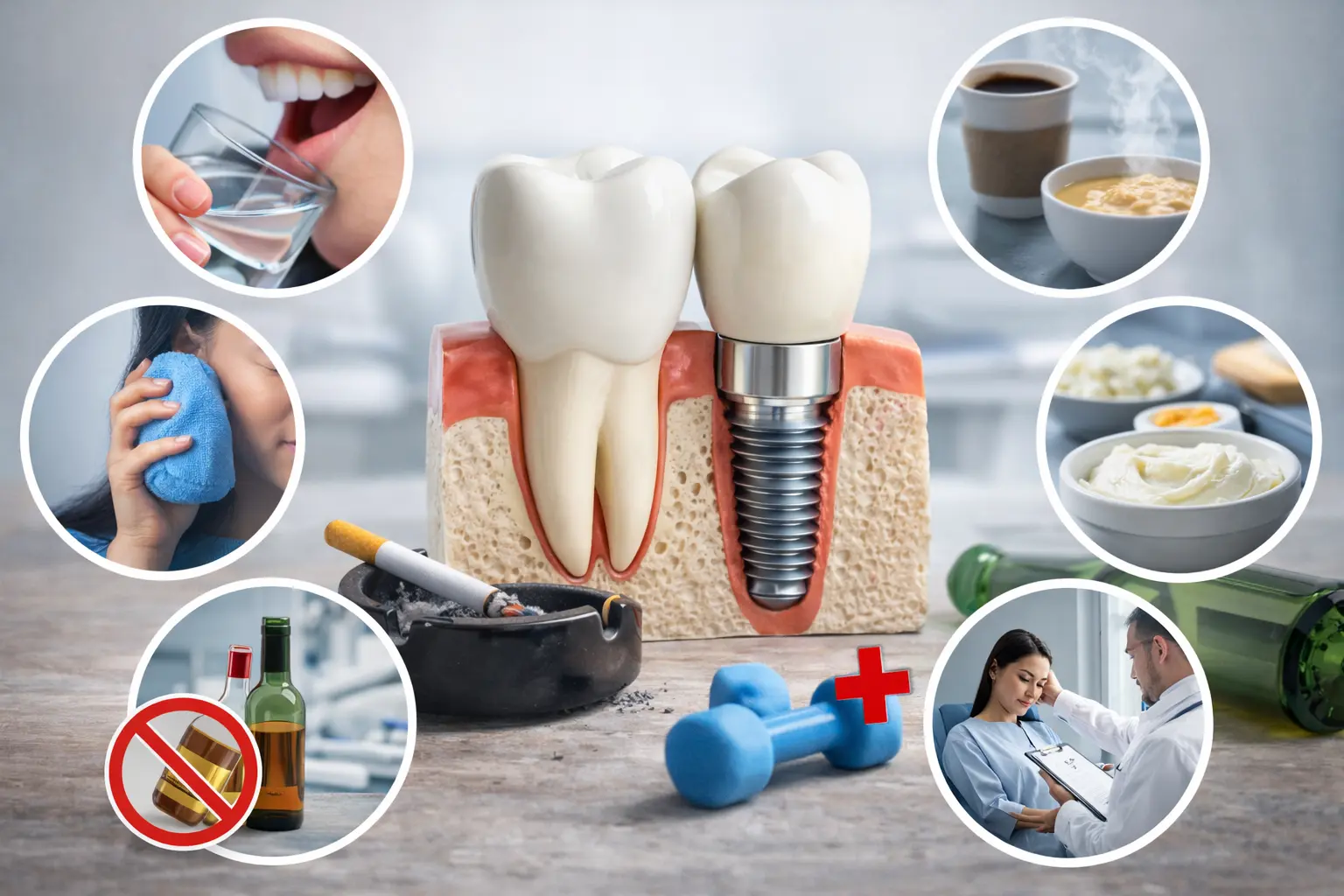
After a dental implant, some soreness, swelling, bleeding or bruising is common, and the discomfort usually lasts up to a week. In the first days, control bleeding with pressure, avoid alcohol for 24 hours and keep your mouth clean as your dental team shows you. Over the years, daily cleaning and regular check-ups help lower the risk of peri-implantitis.
This article is for general information only. It does not replace a consultation, diagnosis or treatment by a doctor.
Your dental team will give you aftercare instructions for your own procedure, and those always come first. Advice can differ with the number of implants, a bone graft or sedation. This guide explains the general dental implant aftercare advice in NHS hospital leaflets, so you know what to expect and what to ask.
What to Expect in the First Few Days
According to Guy’s and St Thomas’ NHS Foundation Trust, you might have some soreness, swelling, bleeding or bruising after an implant. Regular painkillers usually ease the discomfort, which should only last up to a week. Some people also get swelling and bruising on their face.
Cambridge University Hospitals notes that pain after implant surgery is not usually severe and there is relatively little swelling. King’s College Hospital notes that after mouth surgery, a slight ooze from the wound and a bad taste can last a few days. It says this does not mean there is a problem.
Aftercare in the First 24 to 48 Hours
The table brings together advice from NHS hospital leaflets. The Royal Berkshire and King’s College Hospital leaflets cover mouth surgery in general, while the others are about implants. The details differ slightly between hospitals, so follow the instructions your own dental team gives you.
| Topic | What NHS hospital leaflets advise |
| Bleeding | Roll up a clean handkerchief, press it over the wound and close your teeth firmly on it for at least 30 minutes. If the bleeding does not stop, go to your nearest emergency department (Guy’s and St Thomas’). |
| Swelling and bruising | Use an ice pack on the area for 10 minutes each hour for the first 6 hours. Wrap it in a clean cloth and do not put ice directly onto your skin (Guy’s and St Thomas’). |
| Pain relief | Most people need regular painkillers, such as paracetamol or ibuprofen. Take them before the local anaesthetic wears off and for the first 48 hours. Follow the leaflet that comes with them (Guy’s and St Thomas’). Do not take aspirin or painkillers that contain it, as this may cause bleeding. If you take aspirin for another condition, check with your doctor (Royal Berkshire). |
| Rinsing and spitting | Do not rinse or spit on the day of surgery, as this can disturb the blood clot and cause bleeding (Royal Berkshire; King’s College Hospital). |
| Alcohol | Do not have alcohol for 24 hours after treatment (Guy’s and St Thomas’). |
| Smoking | Do not smoke on the day, as it can delay healing (Royal Berkshire). Try to stop before treatment and in the long term (Guy’s and St Thomas’). |
| Activity | Take it easy for the rest of the day and avoid strenuous activity (Royal Berkshire). Avoid physical exertion for the first 24 hours (King’s College Hospital). |
You may read online that you should avoid alcohol for 2 weeks or more. The Guy’s and St Thomas’ leaflet gives 24 hours, but your dentist may advise a longer break, so follow their instructions. If you have been prescribed antibiotics, the Royal Berkshire leaflet notes that some can react with alcohol. Our article on smoking and alcohol after dental implant treatment covers both in more detail.
How Many Days Should You Rest After a Dental Implant?
Guy’s and St Thomas’ says you can return to work on the day after your treatment. Cambridge University Hospitals suggests taking the rest of the day off. It adds that you may need to stay at home for a day or so, depending on your job.
If you had sedation, you will need a little longer to recover before you leave. Several implants are sometimes placed under intravenous sedation or a general anaesthetic. Cambridge University Hospitals says that you then cannot drive, operate machinery or sign legal documents for 48 hours.
The leaflets we reviewed advise against strenuous activity at first. They do not give a date for going back to the gym or contact sports. Ask your dentist when you can return to heavy exercise.
Keeping the Implant Area Clean While It Heals
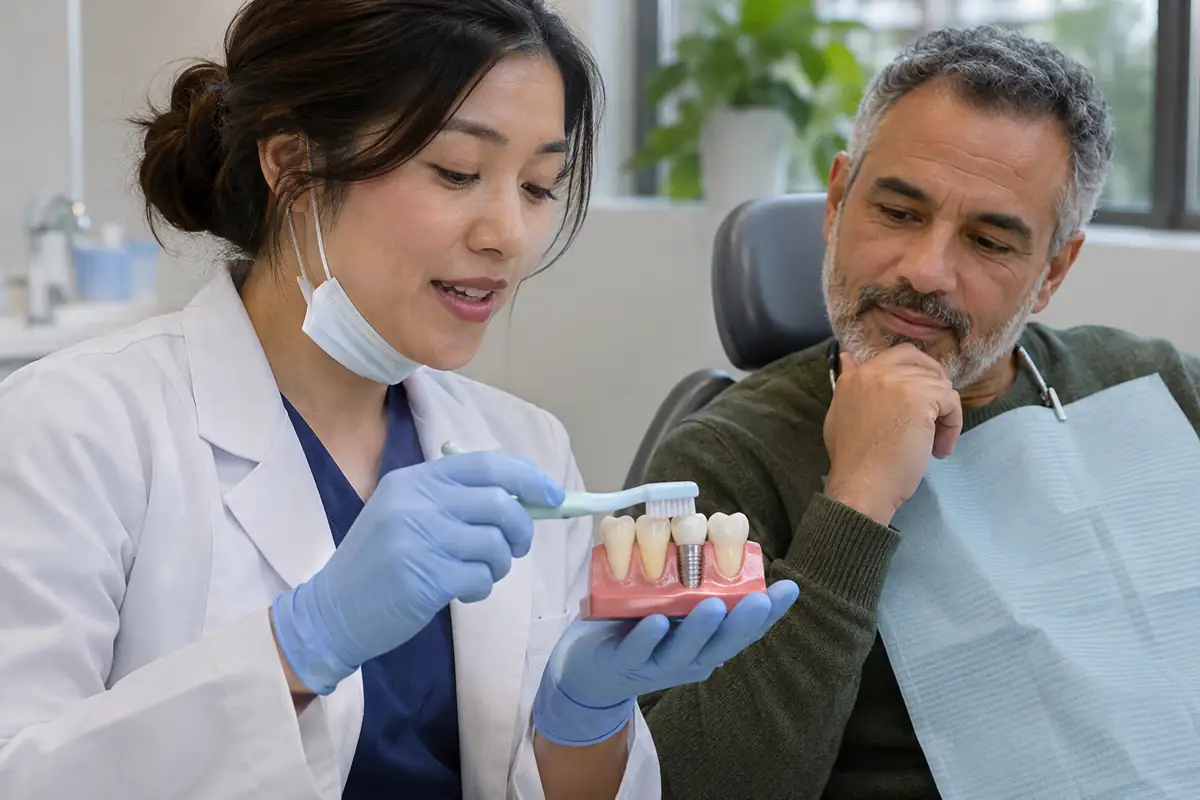
Guy’s and St Thomas’ advises not brushing the area where you had your implant for 1 week. Instead, it recommends a mouthwash that contains chlorhexidine to keep plaque off the area. Hold the mouthwash in your mouth for 1 minute, 2 times a day.
The rest of your mouth still needs cleaning. Leeds Teaching Hospitals says the risk of infection is low if you brush and floss the rest of your mouth normally. It adds that you should use the recommended antimicrobial mouthwash as directed. The Royal Berkshire leaflet advises brushing as normal from the next day, taking care around the wound.
If the area is too sore to clean, Cambridge University Hospitals suggests gently rinsing instead. It advises a mouthwash or warm salt water from the day after surgery. For salt water, dissolve a flat teaspoon of salt in a cup of warm water. King’s College Hospital suggests rinsing after you eat, to stop food sticking to your stitches.
Hospitals differ on the details, such as which mouthwash to use and when to start. Use the products and timings your dental team recommends.
Eating and Drinking
Guy’s and St Thomas’ says you should be able to eat normally after your treatment, although your dentist might recommend soft foods. After minor mouth surgery, the Royal Berkshire leaflet suggests a soft diet for around a week. Our article on nutrition after dental implant treatment explains what to eat and what to avoid while you heal.
Dentures and Temporary Teeth
If you have dentures, Guy’s and St Thomas’ says you might not be able to wear them for up to 2 weeks after treatment. Your dentist or nurse will tell you if this applies to you.
Cambridge University Hospitals’ restorative dentistry leaflet says you may not be able to wear your denture for a few days after surgery. It adds that your denture may need adjusting and relining after this healing period. Do not wear a denture over the implant area until your dental team says you can.
How Long Does Healing Take?
The gum heals long before the bone does. This timeline comes from NHS hospital leaflets and gives typical times only.
| Stage | Typical time | Source |
| Soreness and discomfort | Up to about a week | Guy’s and St Thomas’ |
| Gum healing around the implant | Usually within 1 to 2 weeks | Leeds Teaching Hospitals |
| Stitches | Often removed within the first 1 to 2 weeks; dissolvable stitches may take several weeks to disappear | Leeds Teaching Hospitals; Cambridge University Hospitals |
| Implant bonding to the bone | In most cases 2 to 6 months before the implant is used | Leeds Teaching Hospitals |
| Before the implant can support replacement teeth | Usually at least 3 months; a bone graft can add 4 to 6 months | Guy’s and St Thomas’ |
Your dental team will tell you whether your stitches dissolve or need removing, and when to come back. They will also plan when your crown, bridge or denture is fitted. If you are still choosing a crown material, our comparison of zirconium and porcelain crowns explains the differences. For information on implant treatment and the teeth fitted on implants, see our dental implants and implant restoration pages.
If you are travelling for treatment, these times shape your plan. Cambridge University Hospitals describes two phases: surgery and then restoration. After placement, the implant is usually left to heal in the bone for 3 to 6 months, and sometimes longer. A two-stage implant also needs another minor procedure under local anaesthetic before the restorative phase. Treatment may therefore involve more than one trip, so ask how many visits your plan needs and who will check the implant between them.
In rare cases, the implant does not knit to the bone. Leeds Teaching Hospitals calls this early failure. If it happens, your dentist will discuss other ways to replace the missing tooth.
Signs Your Implant Is Healing Well
The NHS leaflets we reviewed do not give a checklist of healing signs. They do describe what normal recovery looks like. Cambridge University Hospitals says it is very normal to have some discomfort in the week or so after surgery. Guy’s and St Thomas’ says any discomfort should only last up to a week.
The Royal Berkshire leaflet advises painkillers for at least 2 to 3 days, after which the area should start to settle down. If anything worries you, the next section shows when to contact your dentist.
When to Seek Medical Advice
Contact your dentist or the clinic that placed your implant if:
- Bleeding does not stop after pressing on the wound as described above. Guy’s and St Thomas’ advises going to an emergency department in this case.
- You have a lot of pain, swelling or bleeding (Royal Berkshire).
- You notice possible signs of infection, such as a high temperature, a swollen face or jaw, redness or swollen glands in your neck. The NHS lists these among the symptoms of a dental abscess.
- Your lip, chin or tongue feels numb or tingly after the local anaesthetic should have worn off.
- The implant, crown or denture feels loose, or part of it chips or comes off.
The NHS advises calling the emergency services or going to an emergency department if you find it hard to breathe, speak or swallow. The same applies if you have a lot of swelling in your mouth. If your dentist is closed, or you are back home after treatment, look for an urgent dental service where you are.
Long-Term Care and Peri-Implantitis
Over time, the gum around an implant can become inflamed, and the bone that supports it can be lost. The 2023 clinical practice guideline from the European Federation of Periodontology (EFP) describes two stages.
- Peri-implant mucositis: Inflammation of the gum around the implant, without continuing bone loss. Its main sign is bleeding when the gum is gently probed, and there may also be redness, swelling or pus. The guideline says it is treatable with careful control of plaque.
- Peri-implantitis: Inflammation that also causes progressive loss of the bone supporting the implant. The guideline notes that mucositis is believed to always come first. Treatment cannot fully restore the lost support, even when the inflammation is controlled.
The main cause of both is a build-up of plaque bacteria around the implant. The guideline names a history of severe gum disease, poor plaque control and a lack of regular supportive care as important risk factors. It finds the evidence for smoking and diabetes less conclusive.
Leeds Teaching Hospitals lists a smoking habit and poorly controlled diabetes among the factors that raise the risk of losing an implant later on. Its list also includes radiotherapy to the jaws and certain medications, such as bisphosphonates. Cambridge University Hospitals calls smoking a significant risk factor for implant failure.
These conditions are not rare. The guideline cites a 2015 review that estimated peri-implant mucositis in about 43% of patients and peri-implantitis in about 22%.
Daily Cleaning
The NHS advises brushing twice a day for about 2 minutes with a fluoride toothpaste. Adults should use one with at least 1,350 ppm fluoride. Brush last thing at night and on one other occasion. Clean between your teeth with floss or interdental brushes that fit snugly.
For people treated for peri-implantitis, the EFP guideline recommends brushing implants and teeth twice a day, with a manual or rechargeable power brush. It also recommends interdental brushes of the right size once a day.
For everyone with implants, the guideline recommends cleaning instructions tailored to the person. Ask your dentist or hygienist to show you how to clean around your implant.
Check-Ups and Professional Cleaning
There is no fixed check-up interval that suits everyone. For dental check-ups in general, NICE says the interval should be set for each patient based on their risk. For adults, it ranges from 3 to 24 months.
For people with implants, the EFP guideline advises tailoring the recall interval to the person, the implant and the restoration. Cambridge University Hospitals’ restorative dentistry leaflet, for example, advises seeing your dentist or hygienist every 3 to 6 months over the long term. Ask your dentist which interval suits you.
The EFP guideline recommends regular supportive care for people with healthy implants. It stresses the importance of attending these visits and keeping up home care. It also advises dentists to take baseline measurements around the implant within 3 months of the new teeth being fitted. Guy’s and St Thomas’ adds that regular checks of your implants matter, and that dentures need regular follow-up care too.
Other habits help too. The EFP guideline recommends support to stop smoking and, for people with diabetes, good blood sugar control.
The first week after a dental implant is mostly about controlling bleeding and swelling, managing pain and keeping the area clean without disturbing it. Over the following months, the gum and then the bone heal around the implant. After that, daily cleaning and check-ups at the interval your dentist sets help protect it for the long term. If you would like to ask about dental implant treatment, you can contact our team.