In men, direct comparison studies favoured finasteride tablets over minoxidil applied to the scalp, and using both may work better still. Women can use minoxidil outside pregnancy and breastfeeding, but the NHS says they should not use finasteride. Finasteride also carries UK warnings about depression, suicidal thoughts and sexual side effects, so the choice is one to make with a doctor.
This article is for general information only. It does not replace a consultation, diagnosis or treatment by a doctor.
Minoxidil vs Finasteride at a Glance
The NHS describes these two medicines as the main treatments for male pattern baldness. They do not work for everyone, they only work for as long as they are used, and you may have to pay for them.
| Minoxidil (on the scalp) | Finasteride (tablet) | |
| Form | Applied to the scalp, usually once or twice a day | One 1 mg tablet a day |
| Used for | Male and female pattern hair loss | Male pattern hair loss only |
| Supply | Non-prescription in the US | Prescription; in the UK, 1 mg is available on private prescription only |
| How it acts | Exact mechanism not fully understood; it appears to prolong the growth phase of hair | Blocks the enzyme that turns testosterone into DHT |
| Time to see an effect | Often at least 4 months, possibly up to a year | Usually 3 months or more |
| If you stop | Most new hair is lost within a few months | Benefit starts to reverse by 6 months and is gone by 9 to 12 months |
| Main concerns | Scalp irritation and unwanted hair growth | Sexual side effects and mood changes |
| Not for | Pregnancy or breastfeeding; under-18s (US 5% label) | Women, children and adolescents |
How Each Medicine Works
Finasteride blocks an enzyme called type II 5-alpha reductase. This enzyme converts testosterone into dihydrotestosterone (DHT), the hormone involved in pattern hair loss. Our article on what finasteride is covers the medicine in more detail.
Minoxidil works in a different way. According to a 2019 review, its exact mechanism is still not fully understood, although it appears to prolong the growth phase of hair. Read more in our article on what minoxidil is.

Which Works Better for Hair Loss?
The research points towards finasteride in men, but the direct comparisons are limited. MedlinePlus, the US health information site, says finasteride works “slightly better” than minoxidil for male pattern baldness.
- A 2004 open-label trial: Among 65 men treated for 12 months, hair increased in 80% on finasteride and 52% on 5% minoxidil. Both patients and doctors knew which treatment was used.
- A 2015 randomised study: This study assigned 450 Chinese men to treatment for 12 months. Improvement was seen in 80.5% on finasteride, 59% on 5% minoxidil and 94.1% on both.
- A 2025 network meta-analysis: This analysis of 33 studies of male pattern hair loss ranked treatments by effect. Among FDA-approved options, finasteride 1 mg was the most effective oral treatment and 5% minoxidil the most effective topical one.
These percentages are not a forecast of your own result. The studies measured improvement in different ways, and they focused on men.
Which Option Suits Which Situation?
Men with Male Pattern Hair Loss
Where your hair loss is and how far it has gone both matter. The label for one US 5% minoxidil product says it is for the top of the scalp. The main finasteride trials enrolled men aged 18 to 41 with mild to moderate hair loss. Finasteride also tends to work better when started early, according to the American Academy of Dermatology (AAD).
These points are worth raising with your doctor:
- Any history of depression or suicidal thoughts, which the MHRA asks doctors to check before prescribing finasteride
- Any heart disease, because the minoxidil label says to ask a doctor before use
- Any plans to have children, because the UK finasteride information lists reports of infertility and poor semen quality
- Any upcoming PSA test for the prostate, because finasteride lowers PSA levels and this affects how the result is read
- Any other medicine of this type, such as finasteride 5 mg or dutasteride, because the UK product information says not to combine them
Women with Female Pattern Hair Loss
The AAD describes minoxidil as the most-recommended treatment for female pattern hair loss. In the US, 2% and 5% products are approved for it. Check the label of any product you use, because some 5% solutions are for men only. Women who are pregnant, planning a pregnancy or breastfeeding should avoid minoxidil, according to the AAD.
The NHS says women should not use finasteride, and the UK product information contraindicates it in women because of the risk in pregnancy. If taken in pregnancy, it may cause abnormalities of the genitals in a male foetus. Women who are or may be pregnant should not handle crushed or broken tablets.
The evidence for benefit in women is also weak. In a 12-month placebo-controlled trial of 137 post-menopausal women, finasteride showed no improvement. A summary of a Cochrane review found low-quality evidence that it was no more effective than placebo. The AAD notes that a doctor may still prescribe it to a woman who cannot get pregnant, which is off-label in the US.
Hair Loss with Another Cause
Neither medicine treats every kind of hair loss. The minoxidil label says not to use it if your hair loss is sudden or patchy. The same applies if you have no family history of hair loss, or do not know the cause. The NHS lists illness, stress, cancer treatment, weight loss and iron deficiency among the causes of temporary hair loss.
A diagnosis therefore comes first. Our article on androgenetic alopecia explains pattern hair loss.
Side Effects and Safety Warnings
The two medicines carry different risks, so neither is simply the safer choice.
Minoxidil
The AAD lists scalp irritation as a common side effect, with dryness, scaling, itching or redness. Hair can also grow in other places, such as the cheeks and forehead. In women, the AAD says hair loss may increase for the first two to eight weeks. This stops when hair begins to regrow.
Some symptoms need prompt attention. The US label says to stop and ask a doctor if you have chest pain, a rapid heartbeat, faintness or dizziness. The same applies to sudden weight gain, swollen hands or feet, or scalp irritation.
Finasteride
In 12-month trials, sexual side effects linked to the medicine were reported by 3.8% of men on finasteride and 2.1% on placebo. These included lower sex drive, erection problems and reduced semen volume. After the medicine reached the market, reports also described sexual problems that continued after men stopped taking it.
Regulators have strengthened their warnings on mood and sexual side effects:
- MHRA, May 2026: The UK regulator says finasteride is associated with depression, suicidal thoughts and sexual dysfunction, which may persist after treatment stops. Packs include a patient card explaining these risks.
- European Medicines Agency (EMA), 2025: The EMA confirmed suicidal thoughts as a side effect, with a frequency that cannot be estimated. Its safety committee concluded that the benefits still outweigh the risks for approved uses.
The US label adds that 5-alpha reductase inhibitors may increase the risk of high-grade prostate cancer. Men should also report any breast changes, such as lumps, pain or nipple discharge, because male breast cancer has been reported.

Can Minoxidil and Finasteride Be Used Together?
They can be, and some research supports it, mainly in men. The AAD says minoxidil tends to be more effective when used with another hair loss treatment. A 2020 meta-analysis of five randomised trials found better photographic scores and more patients with marked improvement on the combination.
Only two of those five trials compared the combination with finasteride alone, and hair density change showed no significant difference. The UK finasteride product information also states that no data are available on use with topical minoxidil. Using both does not change the advice for women, or the warnings above.
What About Oral Minoxidil?
Minoxidil tablets are approved by the FDA only for severe, treatment-resistant high blood pressure. Taking low doses for hair loss is off-label, which means the medicine has not been approved for this use. A 2025 review says patients should be told this before starting, and that their heart history, swelling and blood pressure should be considered.
According to that review, unwanted hair growth is the most common side effect. Fluid retention was reported in 1.3% to 10% of patients and palpitations in 0.9% to 4%. Evidence for taking minoxidil and finasteride together by mouth is limited. A 2025 evaluation by staff of a UK digital health service called its own results preliminary and asked for randomised trials.
Oral minoxidil is a decision for a doctor, even if you already use the scalp form.
What Results to Expect and When
Do not expect either medicine to restore all lost hair. The AAD says minoxidil can help early hair loss but cannot regrow an entire head of hair. MedlinePlus adds that it is most effective in people under 40 whose hair loss is recent. The US 5% label says to ask a doctor if there is no regrowth in 4 months.
For finasteride, MedlinePlus says improvement should appear within the first 12 months. If there is none by then, further treatment probably will not help, so talk to your doctor about continuing.
Using more does not speed this up. MedlinePlus says exceeding the minoxidil dose gives no greater or faster growth and may increase side effects. The UK finasteride information reports no evidence that a higher dose works better.
Where a Hair Transplant Fits
The NHS notes that hair might continue to thin around a transplant. The AAD says a doctor may recommend hair loss medicine for this reason. Our articles on medication after a hair transplant and combining a transplant with other treatments explain this further.
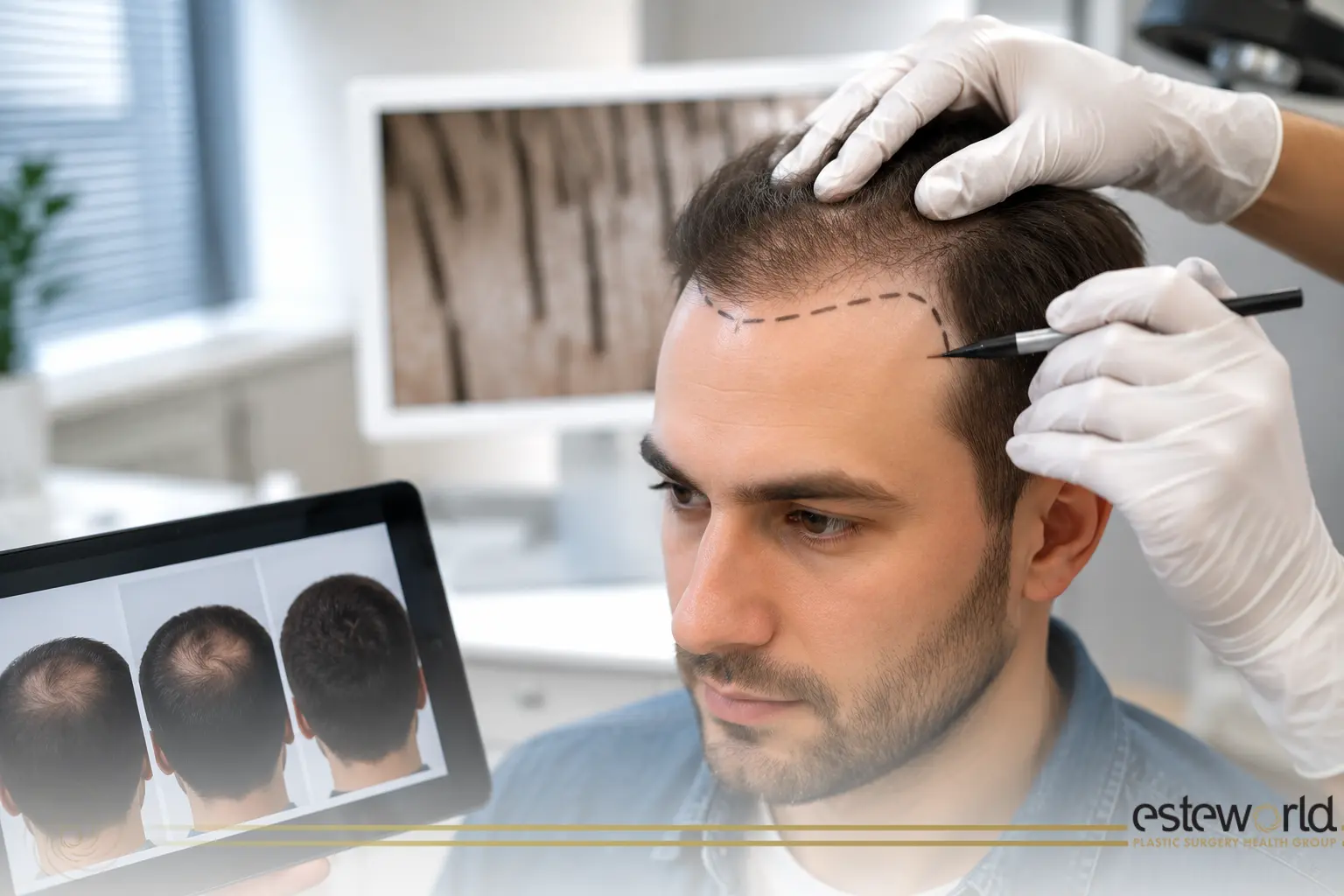
At Esteworld, medical aesthetics physicians (MD) look into the causes of hair loss and assess scalp conditions. A hair transplant specialist assesses you and plans any transplant. For more information, see our hair loss treatments and hair transplant pages.
When to See a Doctor
The NHS advises seeing your own doctor if you are worried about your hair loss, and telling them if it affects your wellbeing. Speak to a doctor before starting either medicine, and also if:
- Your hair loss is sudden or patchy, or you do not know the cause.
- You have sexual side effects while taking finasteride.
- You notice lumps, pain or nipple discharge in the breast area. Report these changes promptly.
Stop finasteride 1 mg immediately and contact your doctor as soon as possible if you develop depression or suicidal thoughts, as the MHRA advises. If you have seriously harmed yourself or feel at risk of serious harm, call emergency services straight away.
Stop minoxidil and ask a doctor if the warning symptoms listed above appear. Call your doctor if you become pregnant while using minoxidil. If you are or may be pregnant and touch broken finasteride tablets, wash the area straight away and call your doctor.
There is no single right choice between minoxidil and finasteride. The decision depends on your diagnosis, your sex, your health and how you weigh the side effects. If you would like to discuss your own hair loss, you can contact our team to ask about a hair analysis.