Hair Transplant in Turkey
- Medically reviewed by Dr. Burak Tuncer
- Last updated: 20 November 2026
A hair transplant in Turkey is a surgical procedure that moves follicular units from the permanent donor area at the back and sides of the scalp into thinning or bald areas, usually performed in Istanbul as an all-inclusive package. The package costs €3,000–€6,000, depending on the treatment technique and individual treatment plan, and covers surgery, 3 nights of hotel accommodation, airport transfers, medication and aftercare; the same procedure costs $9,000–$12,000 in the US and $7,000–$10,000 in the UK for surgery alone.
Grafts are placed with FUE, Sapphire FUE or DHI in one 6–8 hour session under local anaesthesia. Patients stay 2-3 nights, return to work within 3–5 days and see final density at 10–12 months. Esteworld has performed hair transplants in Istanbul since 1994, with more than 50,000 procedures, 24 board-certified surgeons and a Health Tourism Authorisation Certificate from the Turkish Ministry of Health.
1
Session for most patients
6–8 hours
Local
2–3 days
Scalp sensitivity
3–5 days
7–10 days
10–12 months
Not required
- Esteworld: operating since 1994
- 50.000+ hair transplant procedures
- 24 board-certified surgeons
- Health Tourism Authorisation Certificate









How Much Does a Hair Transplant in Turkey Cost?
A hair transplant at Esteworld in Turkey costs approximately $3,300–$6,600 (equivalent to €3,000–€6,000) for an all-inclusive package, depending on the treatment technique, graft requirements and package inclusions. The same procedure costs $7,000–$10,000 in the UK and $9,000–$12,000 in the US, where the quoted price usually covers surgery only.
Three variables move the figure: the number of grafts your Norwood level requires, the technique (DHI, unshaven hair transplantation, FUE and Sapphire FUE), and what the package includes.
| Graft count | Typical Norwood level | Price range (all-inclusive) | Session |
|---|---|---|---|
| 1,500–2,500 | Norwood 2–3 | $1,500 – $1,900 | 1 day |
| 2,500–3,500 | Norwood 3–4 | $1,800–$2,200 | 1 day |
| 3,500–4,500 | Norwood 4–5 | $2,100–$2,500 | 1 day |
| 4,500–6,000 | Norwood 5–6 | $2,400–$3,000 | 1–2 days |
| Country | Avg. cost (3,000 grafts) | Cost per graft | What the price covers |
|---|---|---|---|
| Turkey | $3.300–$6.600 | $1.10–$2.20 | Surgery, medication, hotel, transfers, aftercare kit |
| UK | $7,000–$10,000 | $2.33–$3.33 | Surgery only |
| USA | $9,000–$12,000 | $3.00–$4.00 | Surgery only |
| Germany | $6,000–$9,000 | $2.00–$3.00 | Surgery, sometimes consultation |
| Spain | $5,000–$8,000 | $1.66–$2.66 | Surgery, occasional hotel discount |
| India | $2,000–$3,500 | $0.66–$1.16 | Surgery, transport |
For a country-by-country comparison, see how a hair transplant in the USA vs Turkey and a hair transplant in Turkey vs the UK differ in price, technique and waiting time.
For a full price breakdown by technique, graft count and clinic type, see our guide to hair transplant cost in Turkey. For the most common case, see what a 3,000 grafts hair transplant in Turkey costs and delivers.
How do you pay for a hair transplant in Turkey?
At Esteworld, hair transplant payments are made in two stages. Patients pay a 10% deposit to secure their surgery date, and the remaining 90% is paid at the clinic upon arrival.
What Is Included in an All-Inclusive Hair Transplant Package in Turkey?
An all-inclusive hair transplant package in Turkey covers the procedure itself plus the logistics around it: airport transfers, 2–3 nights of hotel accommodation, blood tests, medication, the aftercare kit, the first wash, and a translator throughout. International flights are not included.
- Pre-operative blood tests and scalp analysis
- Hairline design consultation with the surgeon
- The procedure and local anaesthesia
- Medication for the recovery period
- Aftercare kit (lotion, shampoo, foam)
- First wash performed at the clinic
- VIP airport and hotel transfers
- 2–3 nights' hotel accommodation
- Translator for the full stay
- 12-month follow-up
- International flights
- Extra nights beyond the package
- PRP or exosome sessions booked separately
- Revision procedures within the first 12 months
- Personal expenses
Hair Transplant Techniques in Turkey
Turkish clinics use five hair transplant techniques: FUE, Sapphire FUE, DHI, FUT and robotic FUE. They differ in how grafts are extracted and how the recipient channels are opened, which changes scarring, density potential, recovery time and price. FUE and its sapphire variation account for the large majority of procedures performed in Turkey today. Unshaven and female hair transplants are planning approaches rather than separate techniques, and both are usually carried out with DHI. Some clinics combine Sapphire FUE and DHI in one session and call it a hybrid hair transplant. If you are deciding between the two most common options, compare FUE or DHI
| Technique | Extraction | Channel opening | Best suited to | Grafts / session | Recovery |
|---|---|---|---|---|---|
| FUE | Micro-punch, unit by unit | Steel blade | Most patterns; the default option | 3,000–4,500 | 7–10 days |
| Sapphire FUE | Micro-punch, unit by unit | Sapphire-tipped blade | High-density work and fine hairlines | 3,000–5,000 | 5–8 days |
| DHI | Micro-punch, unit by unit | No separate channel — Choi implanter | Hairline refinement, unshaven work, women | 2,000–3,500 | 5–7 days |
| FUT | Strip harvesting | Steel blade | Very high graft needs, limited donor | 4,000–6,000 | 12–14 days |
| Robotic | Automated punch | Steel or sapphire | Straight hair, uniform donor areas | 2,500–4,000 | 7–10 days |
01
DHI (Direct Hair Implantation)
DHI (Direct Hair Implantation) removes the channel-opening step entirely. The graft is loaded into a Choi implanter pen and placed directly, so the surgeon controls angle, direction and depth in a single movement. This makes DHI the preferred choice for hairline work and for procedures where the head is not shaved. See our DHI hair transplant page for the Choi pen protocol.
02
Sapphire FUE
Sapphire FUE is a variation of FUE in which the recipient incisions are opened with sapphire-tipped blades instead of steel. The sharper, smoother edge produces narrower channels, which allows grafts to sit closer together and shortens crusting time. We cover the density and healing differences on our Sapphire FUE hair transplant page.
03
FUE (Follicular Unit Extraction)
FUE (Follicular Unit Extraction) is the baseline hair transplant method in Turkey.20 Follicular units are removed individually from the donor area with a micro-punch of 0.7–0.9 mm, leaving dot-shaped marks rather than a linear scar. Read the full procedure and recovery detail on our FUE hair transplant page.
04
FUT (Follicular Unit Transplantation)
FUT (Follicular Unit Transplantation) harvests a strip of scalp from the donor area and dissects it into grafts under a microscope. FUT leaves a linear scar but yields a high graft count in one session, which still makes it relevant for advanced hair loss. Details are on our FUT hair transplant page.
05
Unshaven hair transplant
An unshaven hair transplant allows grafts to be extracted and implanted without shaving the recipient area, so the procedure is not visible afterwards. The unshaven approach is limited in graft count and takes longer. See unshaven hair transplant.
06
Robotic hair transplant
A robotic hair transplant uses an automated system for the extraction phase, reducing operator fatigue on long sessions, and works best on straight hair with a uniform donor area. See robotic hair transplant.
07
Female hair transplant
A female hair transplant follows a different planning logic: the hair loss pattern is diffuse rather than receding, and the procedure is usually performed unshaven with DHI. See female hair transplant.
How Many Grafts Do You Need for a Hair Transplant?
The number of grafts depends on the size of the bald area and the density you want to restore. A receding hairline (Norwood 2–3) typically needs 1,200–2,800 grafts; a merging hairline and crown (Norwood 5) needs 3,800–4,800. A density of 35–45 follicular units per cm² reads as natural in most hair types. Advanced cases are covered in our guide to a 5,000 grafts hair transplant22.
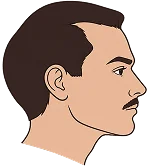
Norwood 2
Slight temple recession
1.200–2.000
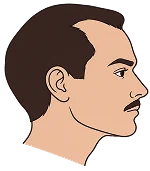
Norwood 3
Defined M-shaped recession
2.000–2.800
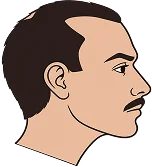
Norwood 3 Vertex
Recession plus early crown thinning
2.500–3.200
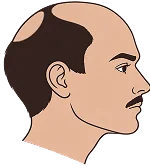
Norwood 4
Wider recession, visible crown
3.000–3.800
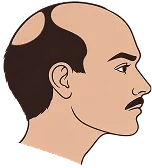
Norwood 5
Hairline and crown merging
3.800–4.800
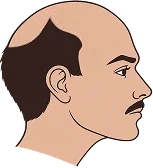
Norwood 6
Bridge of hair gone
4.500–6.000
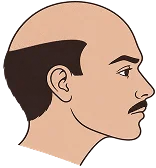
Norwood 7
Only a rim of donor hair remains
6.000+
| Norwood level | What it looks like | Typical graft range | Sessions |
|---|---|---|---|
| Norwood 2 | Slight temple recession | 1,200 – 2,000 | 1 |
| Norwood 3 | Defined M-shaped recession | 2,000 – 2,800 | 1 |
| Norwood 3 Vertex | Recession plus early crown thinning | 2,500 – 3,200 | 1 |
| Norwood 4 | Wider recession, visible crown | 3,000 – 3,800 | 1 |
| Norwood 5 | Hairline and crown merging | 3,800 – 4,800 | 1–2 |
| Norwood 6 | Bridge of hair gone | 4,500 – 6,000 | 2 |
| Norwood 7 | Only a rim of donor hair remains | 6,000+ | 2–3 |
Are You a Suitable Candidate for a Hair Transplant?
You are a suitable candidate for a hair transplant if your hair loss has stabilised, your donor area at the back and sides of the scalp still has healthy density, and you have no uncontrolled systemic condition. Age matters less than pattern stability — most surgeons prefer to operate after 25. Hair type and donor supply also shape the plan: tightly curled follicles call for the protocol described on our Afro hair transplant page, and patients with a depleted scalp donor area may be assessed for a body-to-head hair transplant.
Suitable
- Male pattern hair loss that has been stable for at least 12 months
- Female pattern thinning with a preserved donor region
- Scarring from burns, surgery or previous transplants
- Traction alopecia after the cause has been removed
- Patients whose donor density is above 60 FU/cm²
Requires medical clearance
- Active, rapidly progressing hair loss without prior medical treatment
- Diffuse unpatterned alopecia, where the donor area is also thinning
- Alopecia areata in an active phase
- Uncontrolled diabetes, cardiac disease, kidney or liver failure
- Bleeding disorders such as haemophilia, or anticoagulant therapy
- Active hepatitis B/C or HIV without clinical management
- Pregnancy and breastfeeding
- Patients under 25 with an unstable pattern
Hair Transplant Before and After Results in Turkey
The before and after cases below show Sapphire FUE hair transplants performed at Esteworld, photographed 12 months after surgery, with graft counts from 2,500 to 4,200. Regrowth follows the same sequence in every case: transplanted hairs shed between weeks 2 and 6, new growth begins around month 3, roughly 60% of final density is visible at month 6, and the result matures between months 10 and 12.

Technique
Sapphire FUE
Grafts
3,600
Timeframe
12 months

Technique
Sapphire FUE
Grafts
4,200
Timeframe
12 months

Technique
Sapphire FUE
Grafts
3,100
Timeframe
12 months

Technique
Sapphire FUE
Grafts
2,500
Timeframe
12 months
How to Choose a Hair Transplant Clinic in Turkey
Licence and accreditation
Clinics that treat international patients in Turkey must hold a Health Tourism Authorisation Certificate. Ask for the certificate and check that surgery takes place in a licensed hospital or surgical centre.
Surgeon involvement
Ask who designs the hairline, who opens the channels and who extracts and implants the grafts. A surgeon should plan the operation and be present in the operating room.
Written graft plan and price
A reliable clinic estimates the graft count from your photos, confirms it at the in-person consultation and puts the package contents and price in writing.
Verifiable results and aftercare
Look for before and after cases at 12 months with the graft count stated, and for scheduled follow-up at months 1, 3, 6 and 12.
Who performs hair transplants at Esteworld?
Esteworld has operated in Istanbul since 1994 and has carried out more than 50,000 hair transplant procedures. The team includes 24 board-certified surgeons, the clinic holds a Health Tourism Authorisation Certificate, and this guide is medically reviewed by Dr. Burak Tuncer. [Surgeon’s role at Esteworld: which steps the surgeon performs personally; hospital/surgical centre name in Istanbul; accreditations
Your Hair Transplant Journey in Turkey, Day by Day
A hair transplant trip to Turkey takes 2-3 nights in Istanbul: arrival on day 0, consultation and a 6–8 hour procedure on day 1, a first check on day 2 and the first wash on day 3, after which you can fly home. Booking starts about two weeks earlier with an online photo assessment.
Online assessment
You send photos of the front, top, crown and donor area. A surgeon returns a graft estimate and a technique recommendation.
Planning
Dates, package and technique are confirmed in writing, and pre-operative instructions are sent to you.
Arrival in Istanbul
A VIP transfer meets you at the airport and takes you to your hotel.
Consultation and hairline design
The surgeon analyses your scalp, measures donor density and draws the hairline, which you approve before anything begins.
Procedure
The hair transplant procedure takes 6–8 hours under local anaesthesia: grafts are extracted, channels are opened (or grafts are implanted directly with DHI) and the grafts are placed.
First check
The bandage is removed, the donor area is checked and you are briefed on your medication.
First wash
The first wash is performed at the clinic and you are taught the technique for home.
Follow-up
Your surgeon reviews your photos online at each milestone.
Hair Transplant Recovery Timeline
| Period | What to expect | What to avoid |
|---|---|---|
| Days 1–3 | Swelling on the forehead, redness in the recipient area | Touching or scratching the grafts; bending forward |
| Days 4–10 | Crusting, first washes, gradual reduction in redness | Direct sun, sweating, hats that press on the grafts |
| Days 10–14 | Crusts gone, donor area closed | Swimming, sauna, alcohol |
| Weeks 2–6 | Shock loss — transplanted hairs shed. This is expected and not a failure | Panic-driven use of unprescribed products |
| Months 2–3 | Quiet phase, little visible change | Judging the result |
| Months 3–6 | New growth, roughly 60% of density by month 6 | — |
| Months 10–12 | Final density, texture and direction settle | — |
WE’RE WITH YOU
Post-Op Checkups
Structured clinical reviews
Hair Care Kit
Procedure-specific essentials
Online Doctor Support
Guidance when you need it
Result Tracking
Months 1, 3, 6 and 12
What Our Patients Say
Hair Transplant Risks and Side Effects
| Risk | Frequency | How it is managed |
|---|---|---|
| Forehead swelling | Common, days 2–4 | Head elevation, cold compress |
| Crusting | Expected, days 3–10 | Controlled washing protocol |
| Shock loss | Expected, weeks 2–6 | No intervention; hair returns |
| Temporary numbness | Common, weeks 2–8 | Resolves without treatment |
| Folliculitis | Uncommon | Topical or oral antibiotics |
| Infection | Rare | Sterile technique, prophylactic antibiotics |
| Poor graft survival | Uncommon | Graft-out-of-body time control, correct implantation depth |
| Visible donor depletion | Avoidable | Extraction pattern planning, punch diameter control |
Is a hair transplant in Turkey safe, and what is the success rate?
A hair transplant in Turkey is safe when it is performed in a licensed clinic by a qualified surgical team: the operation uses local anaesthesia, requires no hospital stay and carries the same risk profile as in the UK or the US. With correct graft handling, graft survival above 90% is the expected outcome. Safety problems are linked to unlicensed clinics and to operations run without a surgeon, which is why the clinic checks above matter.
Scope of this guide
Why Do Patients Choose Turkey?
Patients choose Turkey for a hair transplant abroad because the cost per graft is 3–6 times lower than in the UK or the US while the technique and equipment are the same, clinics operate at a volume that few Western centres match, and the entire trip — surgery, hotel, transfers, aftercare — is organised as a single package.
Volume and repetition
Cost structure, not cheaper medicine
Regulation
Logistics
Istanbul is within a 4-hour flight of most of Europe and the Middle East, and direct flights from US cities such as New York, Chicago and Los Angeles take around 10–14 hours.
Frequently Asked Questions About Hair Transplant in Turkey
How long does a hair transplant take in Turkey?
A hair transplant in Turkey takes 6–8 hours on a single day for most patients. Cases above 4,500 grafts may be split over two consecutive days. Including arrival, the first check and the first wash, the whole trip takes 2-3 nights in Istanbul.
How many days do I need to stay in Turkey for a hair transplant?
You need to stay 3 nights in Turkey for a hair transplant. Day 0 is arrival, day 1 is the consultation and surgery, day 2 is the first check, and day 3 is the first wash, after which you can fly home.
Does a hair transplant hurt?
A hair transplant is performed under local anaesthesia and is not painful during the operation. The anaesthetic injections cause brief discomfort at the start; patients who are anxious about needles can choose a hair transplant with sedation. Mild soreness in the donor area for 2–3 days afterwards is managed with the medication included in the package.
When will I see the result of a hair transplant?
Regrowth begins at month 3, about 60% of density is visible at month 6, and the result matures between months 10 and 12. Before that, transplanted hairs shed between weeks 2 and 6, which is expected and not a sign of failure.
Is a hair transplant permanent?
Yes. Grafts taken from the permanent donor zone keep their genetic resistance to DHT and do not fall out. Untransplanted native hair can continue to thin, which is why pattern stability matters before surgery.
Can I have a hair transplant without shaving my head?
Yes. An unshaven hair transplant, usually performed with DHI, leaves the recipient area unshaved, though the graft count achievable in one session is lower than with a fully shaved FUE procedure
Can women have a hair transplant?
Yes. Women with female pattern thinning and a preserved donor region are suitable candidates. Female pattern loss is diffuse rather than receding, so the procedure is usually planned unshaven with DHI.
What is the best age for a hair transplant?
Most surgeons prefer to operate on patients over 25, because the hair loss pattern needs to be stable before permanent grafts are placed. There is no fixed upper age limit as long as donor density and general health are adequate.
What should I eat and avoid after a hair transplant?
A protein- and vitamin-rich diet supports healing. Avoid alcohol and smoking for the first two weeks, along with swimming, sauna and heavy sweating.
What happens if some grafts don't survive?
Graft survival above 90% is the expectation with correct handling. If density is lower than planned, a revision is assessed at the 12-month follow-up, once the final result is visible.
How do I book a hair transplant in Turkey?
Booking a hair transplant in Turkey starts online: you send photos of the front, top, crown and donor area, and a surgeon returns a graft estimate and a technique recommendation. The date, package and price are then confirmed in writing before you book flights.
Related Hair Restoration Treatments
FUE Hair Transplant
Compare method, suitability and recovery.
Sapphire FUE
DHI
FUT
Unshaven Hair Transplant
Female Hair Transplant
Robotic Hair Transplant
Before & After
Cost Guide
Beard Transplant
Restores patchy or missing beard areas with grafts taken from the scalp donor zone.
Eyebrow Transplant
Rebuilds thin or over-plucked eyebrows with single hair grafts.
Hair Loss Treatments
Non – surgical options such or PRP and exosome therapy that support native hair.