How to Hide Your Hair Transplant Scar
Short answer: In the first weeks, redness and small scabs are part of normal healing and are easiest to cover with your existing hair or a loose hat once your clinic allows it. Long term, FUE leaves many small dot-shaped scars and FUT leaves a thin line, and both are usually hidden by surrounding hair. If a scar still shows, options include keeping the hair a little longer, hair fibres, scalp micropigmentation, transplanting hair into the scar or surgical scar revision.
First, Which Kind of Mark Do You Have?
How you hide a mark depends on what it is.
- Healing marks in the first weeks. Redness, swelling and small scabs in the donor and recipient areas are normal after surgery. They are not permanent scars. A 2026 review of FUE complications notes that crusts typically clear within seven to ten days with good care.
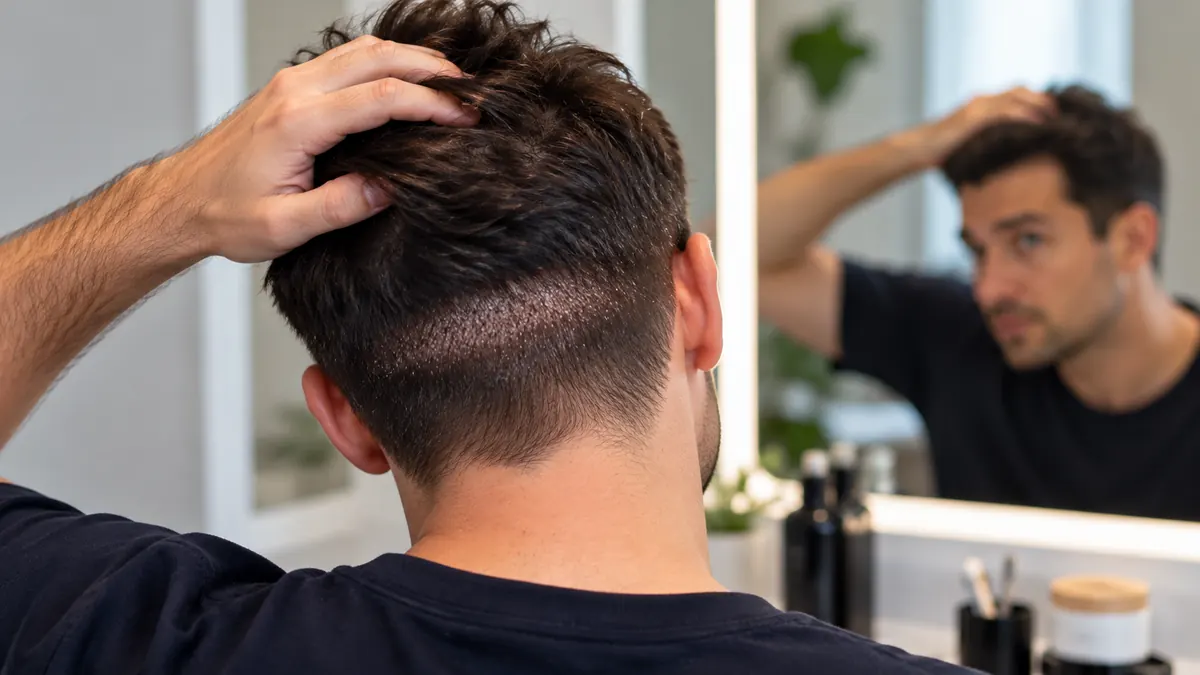
- FUE scars. FUE removes follicles one by one. The NHS says this leaves lots of tiny scars that “will not be very noticeable”. They can show as tiny pale dots when the hair is cut very short. The same 2026 review notes that this is more visible in darker skin types and with short hairstyles.
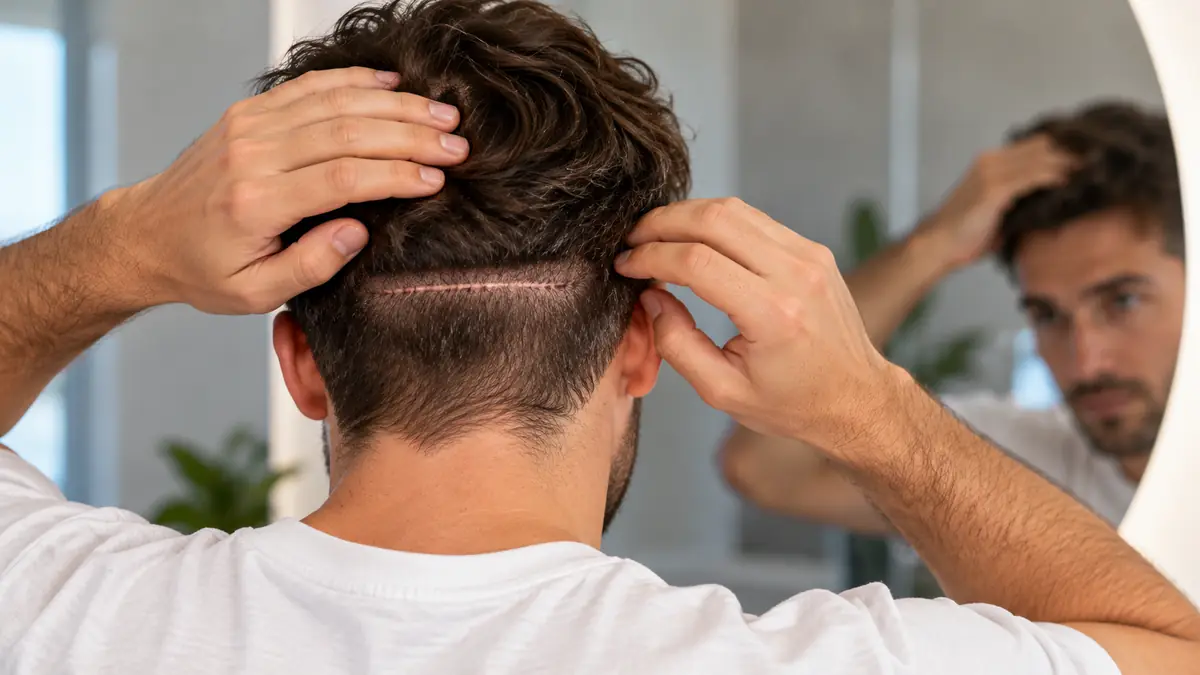
- FUT scar. FUT removes a thin strip of scalp and stitches the edges together. This leaves a linear scar across the back of the head, which the NHS says is usually hidden by hair.
If you are not sure which technique you had, your clinic’s records will tell you. Our comparison of FUE vs FUT explains the differences.
Hiding Your Hair Transplant in the First Weeks
Most people want to return to work or social life before the scalp looks completely normal. In this period:
- Let your hair do the work. If your existing hair is long enough, styling it over the donor area at the back usually covers it well.
- Wear a loose hat when your clinic says you can. It should not press on or rub the grafts. Our article on hair transplant headbands covers other early questions.
- Do not put make-up, concealer, powders or hair fibres on a healing scalp. Wait until your surgeon confirms the skin has healed.
- Plan your time off. The NHS suggests you may need one to two weeks off work.
If you know before surgery that you cannot take time off or need to keep your look discreet, ask whether an unshaven hair transplant is suitable for you.
How to Hide Donor Area Scars Long Term
Choose the right haircut
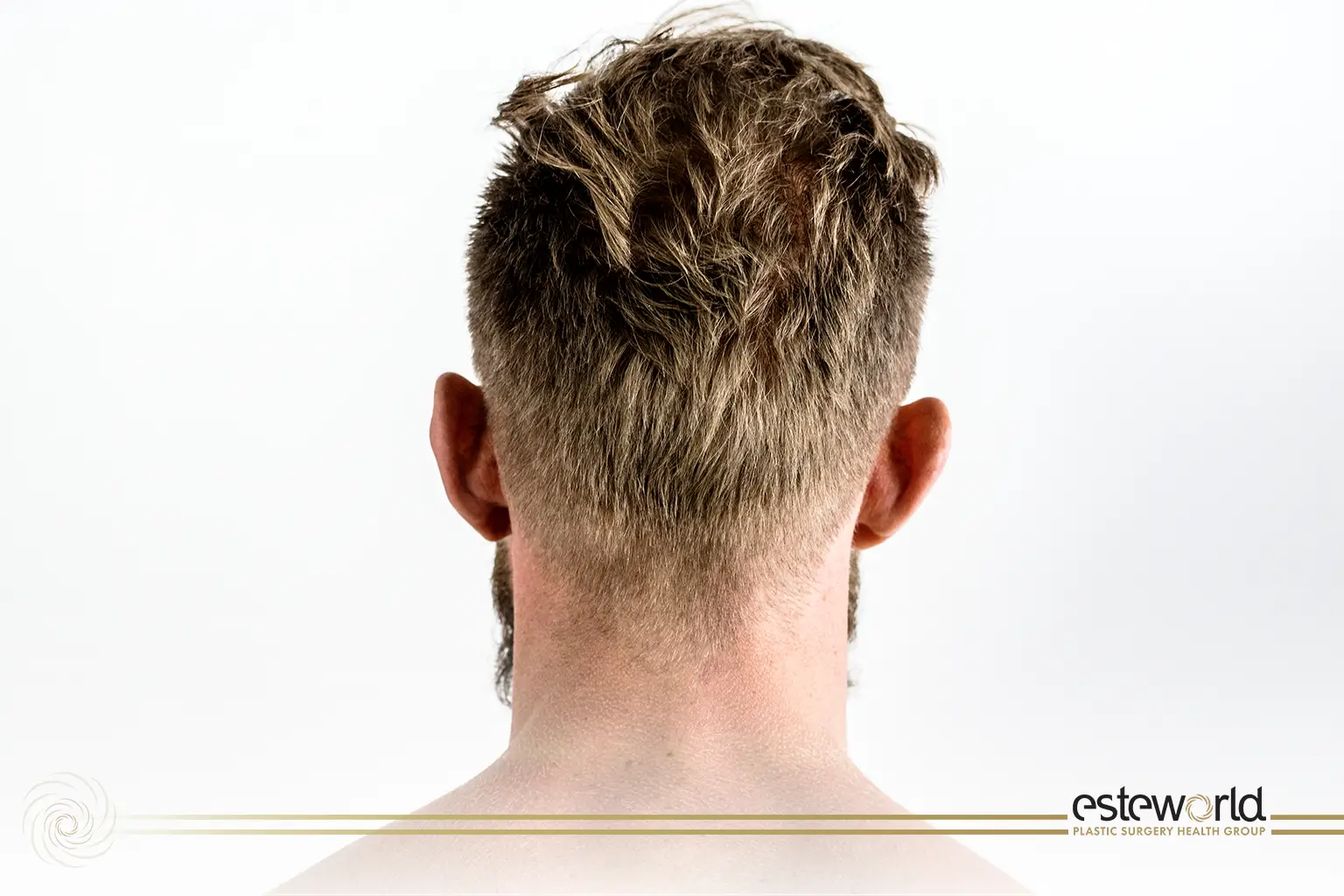
Hair length is the simplest tool. FUE dots and FUT lines are usually hidden when the hair at the back and sides is left slightly longer. Very short clipper cuts are the most likely to reveal them. Ask your barber to leave more length over the donor area, and take a photo of a length that works for you.
Use hair fibres or powders
Hair fibres are made from keratin, rayon or human hair and cling to existing hairs, making them look thicker. A review in the International Journal of Women’s Dermatology explains that they need existing hair to bind to, so they do not work on a completely bare patch, and they must be reapplied daily. Coloured powders, lotions and sprays reduce the colour contrast between hair and scalp and are easy to wash out. These products are useful for small areas of thinning around a scar. See our overview of hair loss products for thinning hair.
Scalp micropigmentation (SMP)
Scalp micropigmentation places tiny dots of pigment in the skin to mimic short hair follicles. It does not grow hair, but it reduces the contrast between a pale scar and the surrounding scalp. A 2021 review in the Indian Journal of Plastic Surgery describes SMP as an excellent non-surgical option for camouflaging a FUT scar, and the 2026 FUE review lists it among the ways to camouflage pale FUE dots.
The colour can change over time, and a 2023 review notes that regular touch-up sessions help maintain results. A natural result depends heavily on the practitioner’s skill. Read more about combining scalp micropigmentation with a hair transplant.
Transplanting hair into the scar
Grafts can be placed into a scar so that hair grows through it. The 2021 review lists this, alongside scar revision, as a way to manage a wide FUT scar. Scar tissue has a different blood supply from healthy scalp, so your surgeon will assess whether it is likely to work for you. Any graft used this way comes from your donor area, so the decision also depends on how much donor hair you have.
Surgical scar revision
A wide or stretched FUT scar can sometimes be cut out and closed again (Garg and Garg, 2021), using a technique designed to let hair grow through the line. A review in the Journal of Cutaneous and Aesthetic Surgery lists closure methods, including trichophytic closure, that reduce scar problems in strip surgery. Revision is not suitable for every scar and is planned case by case. See hair transplant revision surgery.
Raised or thick scars
Rarely, a scar becomes raised, thick or itchy, which may be a hypertrophic scar or a keloid. These need medical treatment rather than camouflage. The 2021 review describes a keloid after strip surgery treated with steroid injections into the scar. If you have had keloids before, tell your surgeon before any procedure.
Do Hair Transplant Scars Go Away?
Healing marks such as redness and scabs fade within weeks. Permanent scars do not disappear completely, but they usually become flatter and less noticeable as they mature over the following months. How visible they end up depends on the technique, how many grafts were taken, your skin type and your hairstyle.
Pale spots can also appear around FUE sites weeks to months after surgery, according to the 2026 review. Taking too many grafts from one area can leave a thin, uneven donor area that is harder to hide. This is why careful donor planning matters more than any camouflage afterwards.
How to Reduce Scar Visibility from the Start
- Tell your surgeon how you wear your hair. If you like very short hair, this can affect which technique is recommended.
- Ask about donor planning. Even spacing and sensible limits on how many grafts are taken help keep the donor area looking natural. Our guide to donor area recovery explains more.
- Mention any history of abnormal scarring. A personal or family history of raised scars is a risk factor the surgeon needs to know about.
- Follow your aftercare instructions, avoid smoking and do not pick at scabs.
If you would like a scar or a previous transplant assessed, you can contact our team.
This article is for general information and does not replace a medical consultation. Your surgeon will advise you on the right option for your scar.