What Is FUE Hair Transplant?
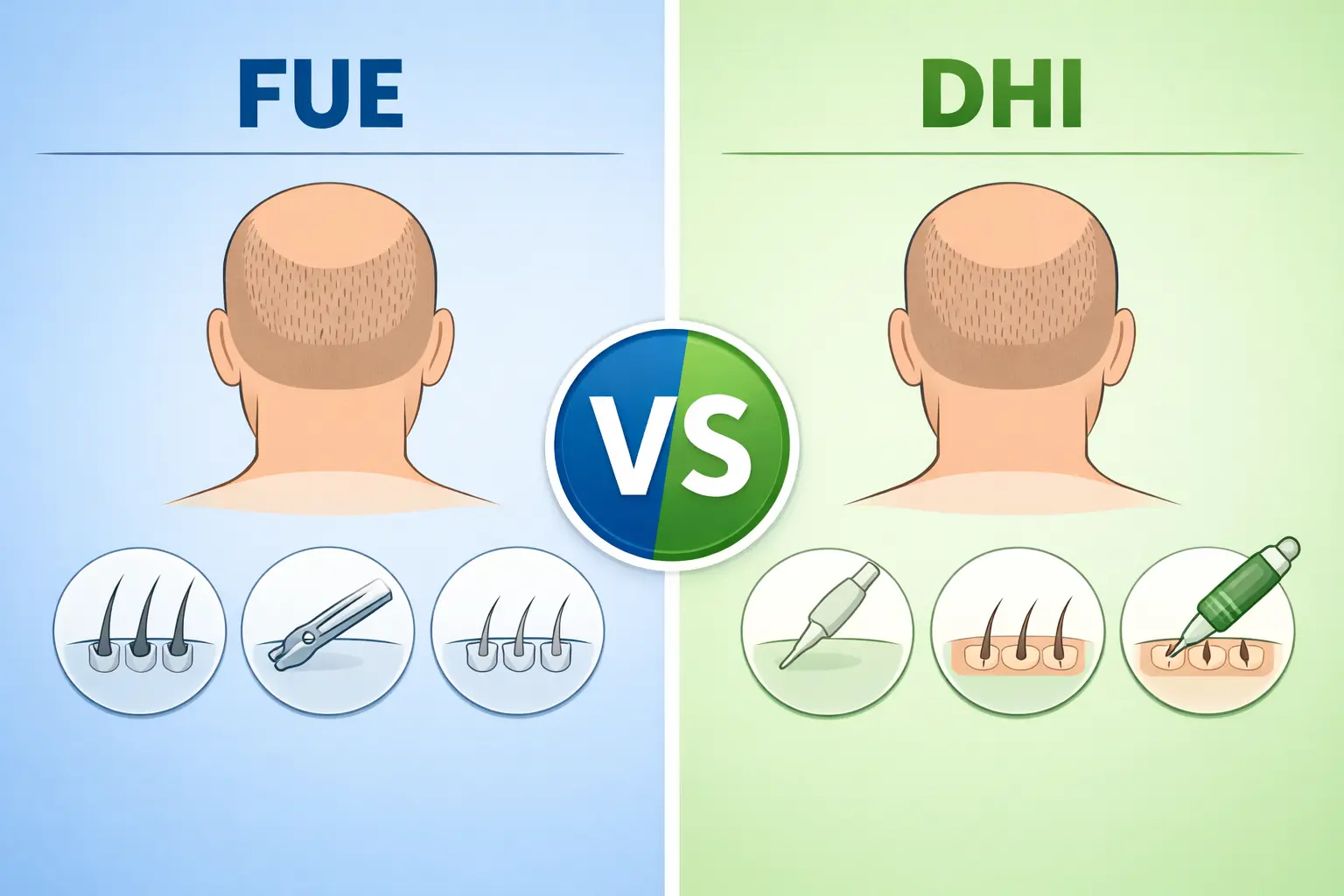
FUE (Follicular Unit Extraction) is one of the most commonly preferred modern hair transplant methods today. In this technique, hair follicles are extracted one by one from the donor area using micro motors and then transplanted into bald or sparse areas. The fact that no incisions or stitches are required during the procedure is one of the prominent features of the FUE method.
Since the hair follicles are extracted individually, the risk of visible scarring in the donor area is low. This contributes to a more comfortable healing process. The FUE method is frequently preferred, especially for individuals experiencing advanced hair loss, as it allows transplantation over large areas.
The planning stage is of great importance in FUE hair transplantation. Determining the hairline, distributing the transplantation area, and deciding on the number of grafts are planned by taking into account the individual’s facial structure, hair characteristics, and existing hair density. With proper planning, a natural and balanced appearance is aimed.
This method can be applied using different techniques such as classic FUE and sapphire FUE. Which technique will be preferred is determined through expert evaluation based on the individual’s hair structure and needs.
What Is DHI Hair Transplant?
DHI (Direct Hair Implantation) is a hair transplant method in which hair follicles are placed directly into the recipient area using a special pen. In this technique, after the hair follicles are taken from the donor area, they are implanted using a special device called a Choi implanter, without opening channels.
Since channel opening and implantation are performed simultaneously in the DHI hair transplant method, the transplantation process progresses in a more controlled manner. This allows denser implantation with accurately planned angles and directions, especially in sensitive areas such as the hairline and frontal region.
The DHI method is generally preferred by individuals who want hair transplantation in limited areas and aim to preserve their existing hair. However, whether it is suitable for each patient should be evaluated by a specialist based on hair loss condition and expectations.
What Are the Advantages of the FUE Hair Transplant Method?
- Since hair follicles are extracted individually from the donor area, the risk of visible scarring is low.
- As it does not require incisions or stitches, the healing process is generally more comfortable.
- It allows hair transplantation over large areas.
- Hair from the donor area can be extracted while preserving natural distribution.
- A natural hairline can be created with proper planning.
- It offers flexibility as it can be applied with different techniques such as sapphire FUE.
- The return to daily life is short for most patients.
- It is suitable for both frontal and crown area transplantation.
What Are the Advantages of the DHI Hair Transplant Method?
- Since hair follicles are placed directly into the recipient area without opening channels, it provides a more controlled application.
- Thanks to the Choi implanter pen, the direction and angle of hair follicles can be adjusted more precisely.
- Natural results can be achieved, especially in areas requiring detail such as the hairline and frontal region.
- It allows transplantation between existing hair.
- It may offer unshaven or partially shaved application options.
- It enables denser and more concentrated implantation.
- As the implantation process progresses in a controlled manner, the time hair follicles remain outside the body may be reduced.
It is suitable for individuals who want hair transplantation in limited areas.