Hair Transplant in Turkey
- Medically reviewed by: Dr. Burak Tuncer
- Last updated: 25 September 2026
Hair transplant in Turkey is a surgical procedure in which follicular units are extracted from a permanent donor area at the back and sides of the scalp and implanted into thinning or bald regions. Most patients need 2,500–5,000 grafts, the operation takes 6–8 hours under local anaesthesia, and final density is visible at 10–12 months.
1
Number of procedures
6–8 hours
Local
2–3 days
3–5 days
7–10 days
10–12 months
Not required
- Operating since 1994
- 50.000+ hair transplant procedures
- 24 board-certified surgeons
- Health Tourism Authorisation Certificate










What Does a Hair Transplant in Turkey Cost?
A hair transplant in Turkey costs between $1,800 and $2,500 for an all-inclusive package covering roughly 3,000 grafts, or $0.60–$0.83 per graft. The same procedure costs $7,000–$10,000 in the UK and $9,000–$12,000 in the US, where the quoted price usually covers surgery only.
Three variables move the figure: the number of grafts your Norwood level requires, the technique, and what the package includes.
| Graft count | Typical Norwood level | Price range (all-inclusive) | Session |
|---|---|---|---|
| 1,500–2,500 | Norwood 2–3 | $1,500–$1,900 | 1 day |
| 2,500–3,500 | Norwood 3–4 | $1,800–$2,200 | 1 day |
| 3,500–4,500 | Norwood 4–5 | $2,100–$2,500 | 1 day |
| 4,500–6,000 | Norwood 5–6 | $2,400–$3,000 | 1–2 days |
| Country | Avg. cost (3,000 grafts) | Cost per graft | What the price covers |
|---|---|---|---|
| Turkey | $1,800–$2,500 | $0.60–$0.83 | Surgery, medication, hotel, transfers, aftercare kit |
| UK | $7,000–$10,000 | $2.33–$3.33 | Surgery only |
| USA | $9,000–$12,000 | $3.00–$4.00 | Surgery only |
| Germany | $6,000–$9,000 | $2.00–$3.00 | Surgery, sometimes consultation |
| Spain | $5,000–$8,000 | $1.66–$2.66 | Surgery, occasional hotel discount |
| India | $2,000–$3,500 | $0.66–$1.16 | Surgery, transport |
For a full price breakdown by technique, graft count and clinic type, see our hair transplant Turkey cost guide.
What Is Included in an All-Inclusive Hair Transplant Package?
- Surgeon's fee and operating theatre
- Anaesthesia and anaesthetist
- Pre-operative blood tests and health check
- 1–2 nights hospital stay where required
- 4–6 nights hotel accommodation
- All airport ⇄ hotel ⇄ hospital transfers
- Multilingual patient coordinator
- Medication, dressings and compression garments
- Post-operative checks before departure
- 12 months of online follow-up with your surgeon
- International flights
- Extra nights beyond the package
- Revision surgery (if later required)
- Personal expenses
Hair Transplant Techniques in Turkey
| Technique | Extraction | Channel opening | Best suited to | Grafts / session | Recovery |
|---|---|---|---|---|---|
| FUE | Micro-punch | Steel blade | Most patterns | 3,000–4,500 | 7–10 days |
| Sapphire FUE | Micro-punch | Sapphire blade | High density | 3,000–5,000 | 5–8 days |
| DHI | Micro-punch | Choi implanter | Hairline / unshaven | 2,000–3,500 | 5–7 days |
| FUT | Strip | Steel blade | High graft needs | 4,000–6,000 | 12–14 days |
| Robotic | Automated punch | Steel / sapphire | Uniform donor areas | 2,500–4,000 | 7–10 days |
01
DHI (Direct Hair Implantation)
removes the channel-opening step entirely. The graft is loaded into a Choi implanter pen and placed directly, so the surgeon controls angle, direction and depth in a single movement. This makes it the preferred choice for hairline work and for procedures where the head is not shaved. See our DHI hair transplant page for the Choi pen protocol.
02
Sapphire FUE
is a variation of FUE in which the recipient incisions are opened with sapphire-tipped blades instead of steel. The sharper, smoother edge produces narrower channels, which allows grafts to sit closer together and shortens crusting time. We cover the density and healing differences on our Sapphire FUE hair transplant page.
03
FUE (Follicular Unit Extraction)
is the baseline method. Follicular units are removed individually from the donor area with a micro-punch of 0.7–0.9 mm, leaving dot-shaped marks rather than a linear scar. Read the full procedure and recovery detail on our FUE hair transplant page.
04
FUT (Follicular Unit Transplantation)
harvests a strip of scalp from the donor area and dissects it into grafts under a microscope. It leaves a linear scar but yields a high graft count in one session, which still makes it relevant for advanced hair loss. Details on our FUT hair transplant page.
05
Unshaven hair transplant
allows grafts to be extracted and implanted without shaving the recipient area, so the procedure is not visible afterwards. It is limited in graft count and takes longer. See unshaven hair transplant.
06
Robotic hair transplant
uses an automated system for the extraction phase, reducing operator fatigue on long sessions. See robotic hair transplant.
07
Female hair transplant
follows a different planning logic: the pattern is diffuse rather than receding, and the procedure is usually performed unshaven with DHI. See female hair transplant.
How Many Grafts Do You Need?
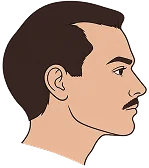
Norwood 2
Temple recession
1.200–2.000
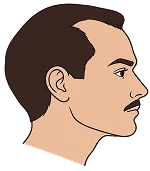
Norwood 3
M-shaped recession
2.000–2.800
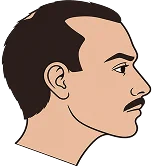
Norwood 3V
Early crown thinning
2.500–3.200
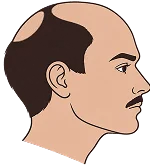
Norwood 4
Hairline + crown
3.000–3.800
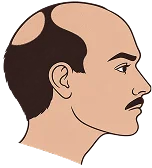
Norwood 5
Areas merging
3.800–4.800
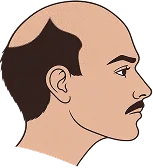
Norwood 6
Bridge is gone
4.500–6.000
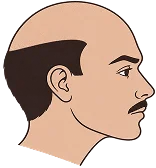
Norwood 7
Donor rim only
6.000–7.000
| Norwood level | What it looks like | Typical graft range | Sessions |
|---|---|---|---|
| Norwood 2 | Slight temple recession | 1,200 – 2,000 | 1 |
| Norwood 3 | Defined M-shaped recession | 2,000 – 2,800 | 1 |
| Norwood 3 Vertex | Recession plus early crown thinning | 2,500 – 3,200 | 1 |
| Norwood 4 | Wider recession, visible crown | 3,000 – 3,800 | 1 |
| Norwood 5 | Hairline and crown merging | 3,800 – 4,800 | 1–2 |
| Norwood 6 | Bridge of hair gone | 4,500 – 6,000 | 2 |
| Norwood 7 | Only a rim of donor hair remains | 6,000+ | 2–3 |
Are You a Suitable Candidate?
Suitable
- Stable male pattern hair loss
- Female thinning with preserved donor region
- Scarring from burns or previous surgery
- Resolved traction alopecia
- Donor density above 60 FU/cm²
Requires medical clearance
- Active or rapidly progressing hair loss
- Diffuse unpatterned alopecia
- Active alopecia areata
- Uncontrolled systemic illness
- Bleeding disorders or anticoagulants
- Pregnancy or breastfeeding
- Unstable pattern under age 24
Before and After Results

Technique
Sapphire FUE
Grafts
3,600
Timeframe
12 months

Technique
Sapphire FUE
Grafts
4,200
Timeframe
12 months

Technique
Sapphire FUE
Grafts
3,100
Timeframe
12 months

Technique
Sapphire FUE
Grafts
2,500
Timeframe
12 months
Your Hair Transplant Journey in Turkey, Day by Day
Online assessment
Planning
Arrival
Airport transfer and hotel check-in.
Consultation & procedure
First check
Bandage removal and medication briefing.
First wash
Clinic wash and home-care training.
Return home
Airport transfer with your aftercare kit.
Follow-up
Online reviews at months 1, 3, 6 and 12.
Recovery Timeline
| Period | What to expect | What to avoid |
|---|---|---|
| Days 1–3 | Swelling and redness | Touching grafts; bending forward |
| Days 4–10 | Crusting and first washes | Sun, sweating, tight hats |
| Days 10–14 | Crusts gone; donor area closed | Swimming, sauna, alcohol |
| Weeks 2–6 | Expected shock loss | Unprescribed products |
| Months 2–3 | Quiet phase | Judging the result |
| Months 3–6 | New growth; ~60% by month 6 | — |
| Months 10–12 | Final density and texture settle | — |
WE’RE WITH YOU
Post-Op Checkups
Structured clinical reviews
Hair Care Kit
Procedure-specific essentials
Online Doctor Support
Guidance when you need it
Result Tracking
Months 1, 3, 6 and 12
What Our Patients Say
Risks and Side Effects
| Risk | Frequency | How it is managed |
|---|---|---|
| Forehead swelling | Common, days 2–4 | Head elevation, cold compress |
| Crusting | Expected, days 3–10 | Controlled washing protocol |
| Shock loss | Expected, weeks 2–6 | No intervention; hair returns |
| Temporary numbness | Common, weeks 2–8 | Resolves without treatment |
| Folliculitis | Uncommon | Topical or oral antibiotics |
| Infection | Rare | Sterile technique, antibiotics |
| Poor graft survival | Uncommon | Controlled handling and implantation depth |
| Visible donor depletion | Avoidable | Extraction planning and punch control |
Scope of this guide
Why Do Patients Choose Turkey?
Volume and repetition
Istanbul clinics perform hair transplants daily, building surgical consistency.
Cost structure
Regulation
Logistics
Frequently Asked Questions
How much does a hair transplant cost in Turkey?
What does all-inclusive actually mean?
It means the operation, pre-operative tests, hotel, transfers, interpreter, medication, aftercare kit and follow-up are covered by one price. It does not mean flights. The term is unregulated, so ask any clinic for a written list of inclusions and exclusions.
Why is a hair transplant so much cheaper in Turkey than in the UK?
Lower clinical operating costs, far higher case volume, a bundled package model and currency differences. A UK clinic charging per graft with no accommodation or aftercare included is not pricing the same thing as a Turkish all-inclusive package.
Is a hair transplant covered by the NHS or by US insurance?
No. Hair transplantation for pattern hair loss is classified as a cosmetic procedure and is not funded by the NHS or covered by standard US health insurance. Cases involving burns, trauma or scarring may occasionally be assessed differently.
What is the cheapest time of year for a hair transplant in Turkey?
Package prices do not change seasonally at our clinic. Flight prices do. Travelling outside July, August and the December holiday period will usually reduce your total trip post by £[XXX] to £[XXX].
Will the price I am quoted change after I arrive?
No. Your package price is confirmed in writing after the photographic assessment and does not change on arrival unless you request a change to the treatment plan. If your in-person assessment indicates a different graft need, we tell you before the operation, not after.
Hair Restoration Treatments & Guides
FUE Hair Transplant
Compare method, suitability and recovery.
Sapphire FUE
DHI
FUT
Unshaven Hair Transplant
Female Hair Transplant
Robotic Hair Transplant
Before & After
Cost Guide
Beard Transplant
Eyebrow Transplant
Hair Loss Treatments

Written by: Dr. Burak Tuncer
Medically reviewed by: Dr. Burak Tuncer
- Published: 24 April 2024
- Updated:25 September 2026
Get your free hair analysis
Confidential photo review · no obligation