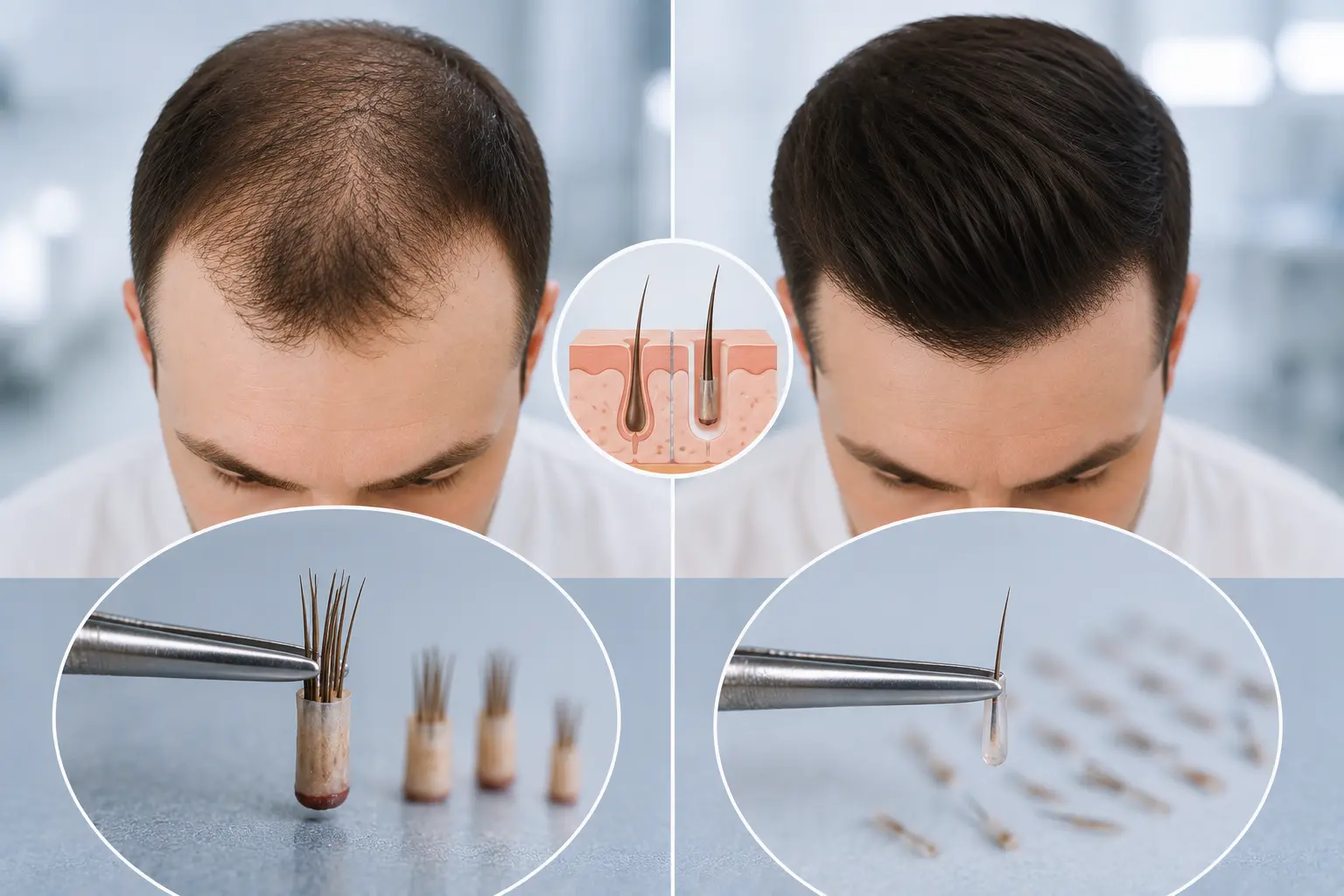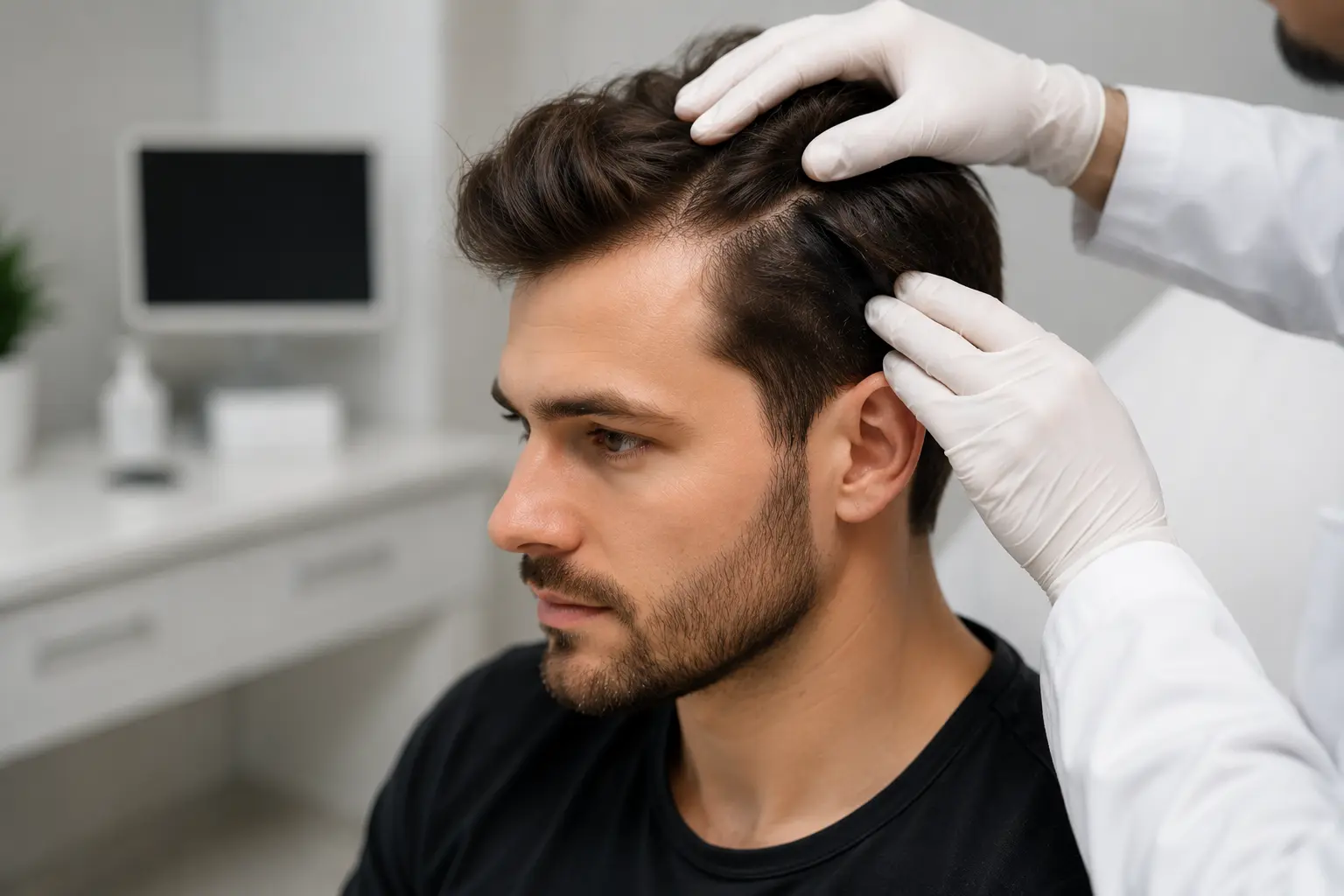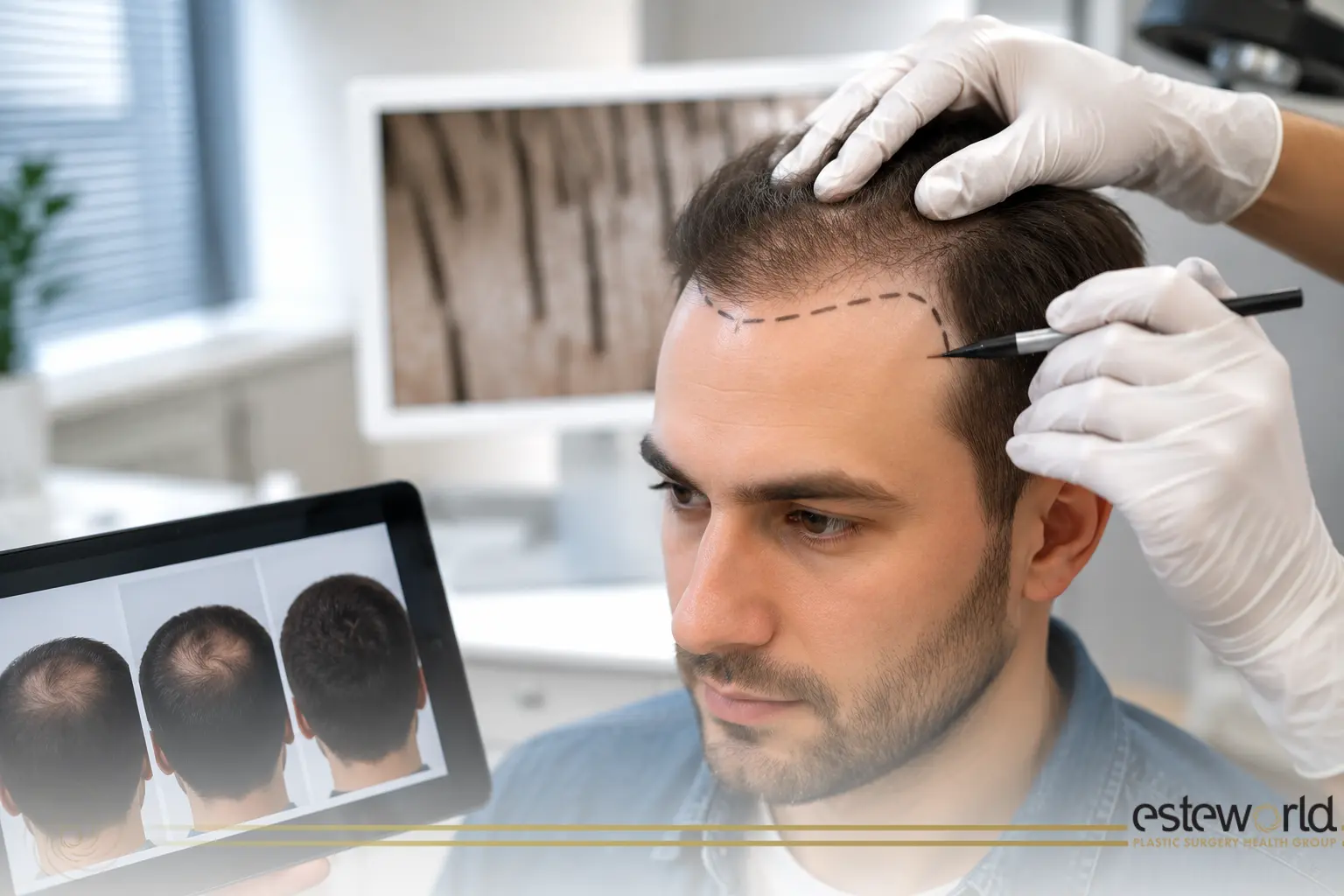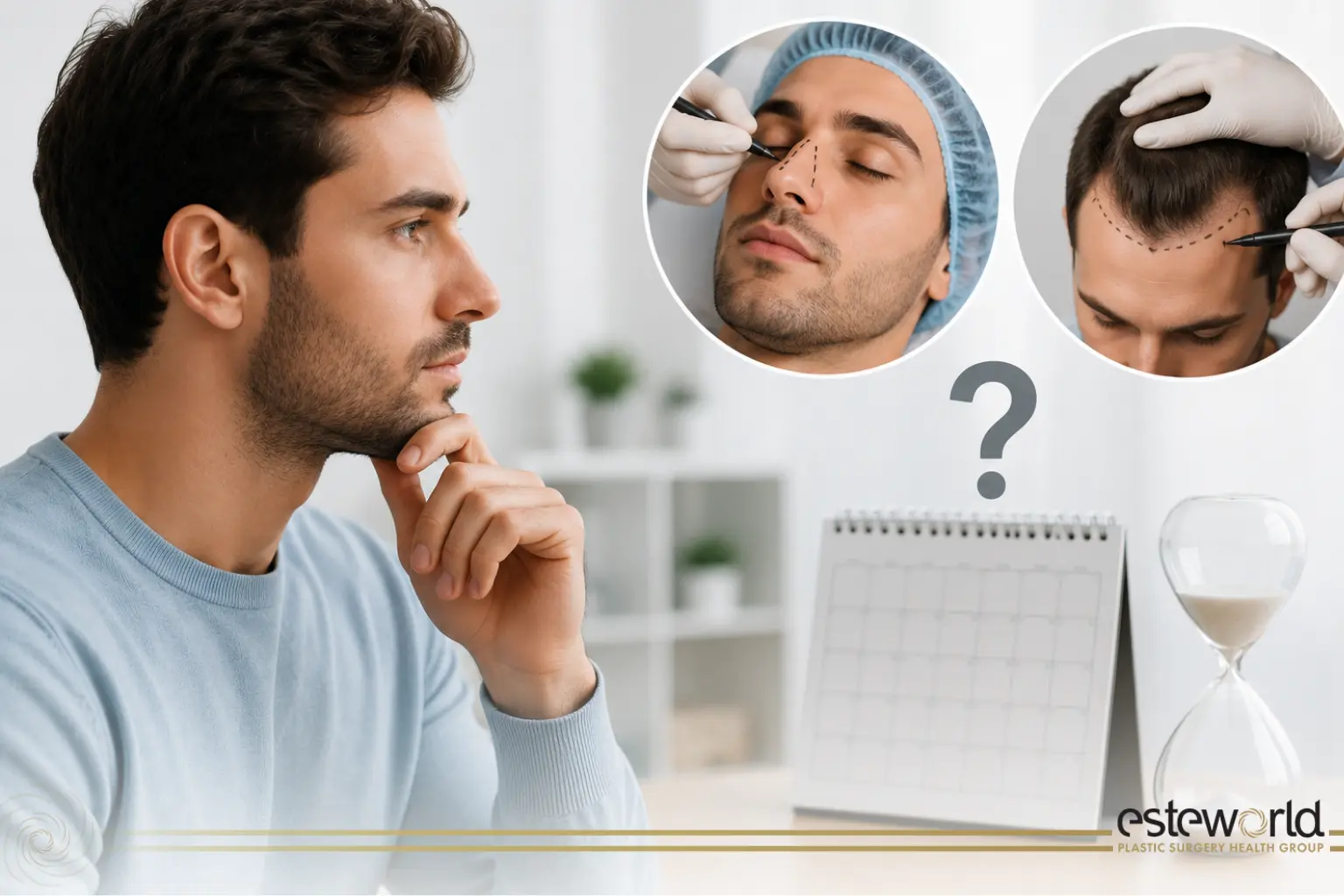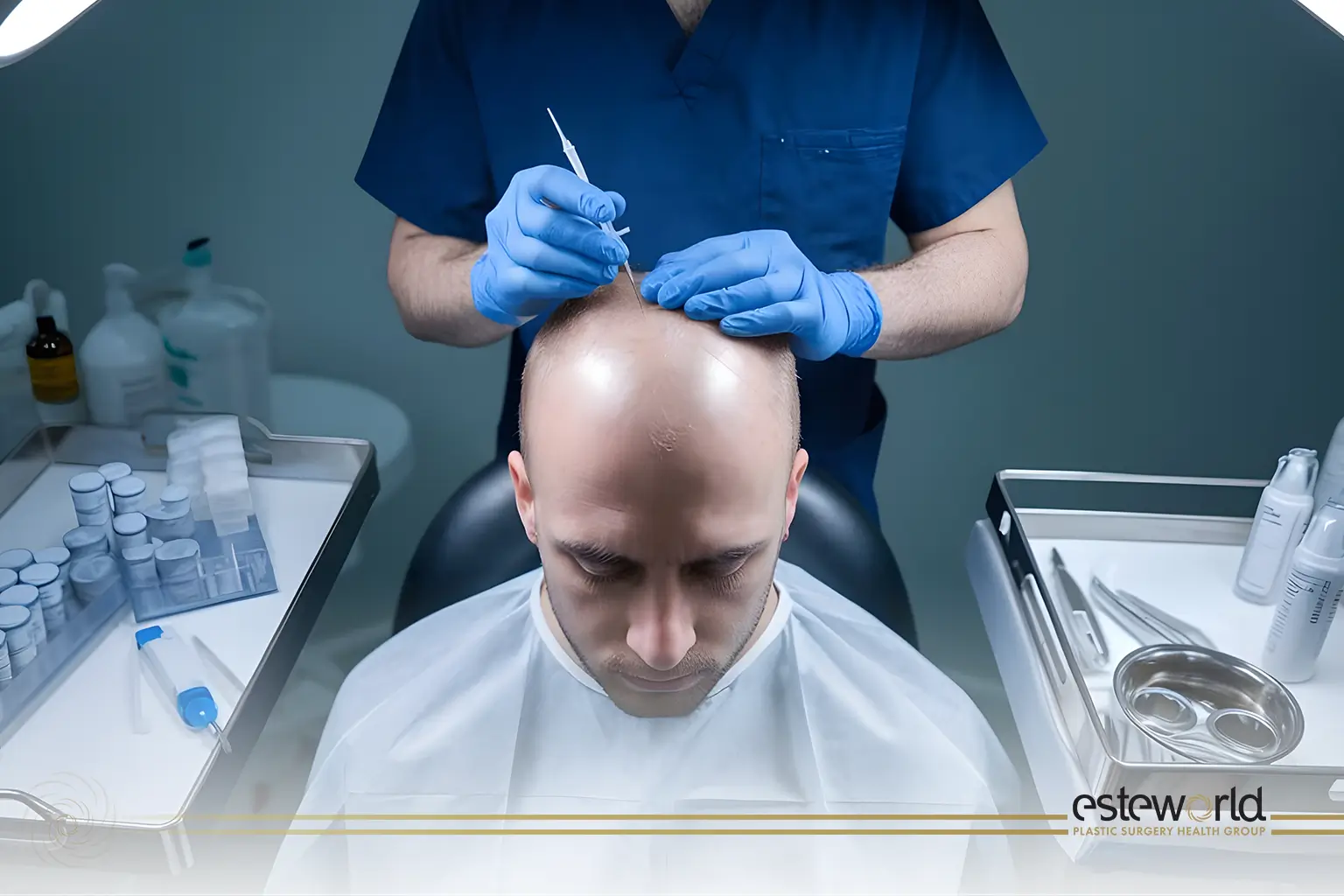

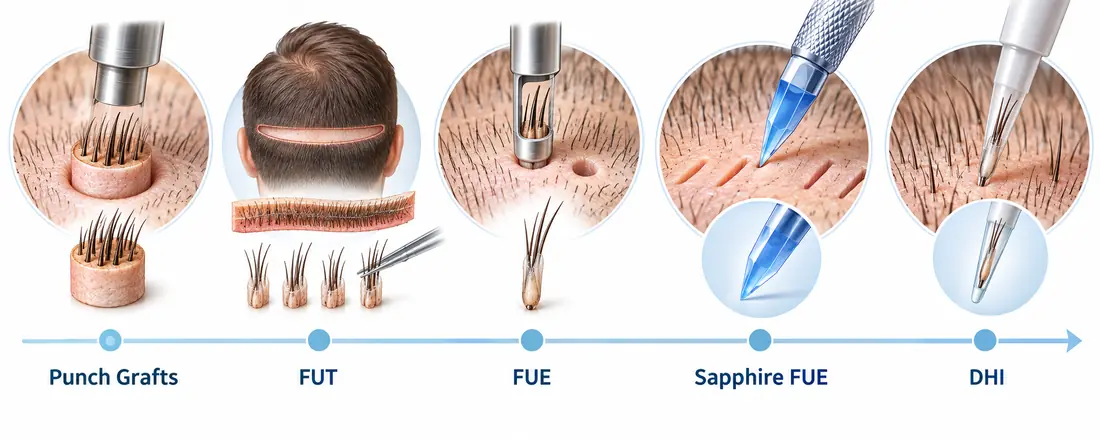
Hair transplant techniques have evolved from large punch grafts and strip-based procedures to follicular unit transplantation, FUE and modern implantation approaches such as DHI. The main change has been a shift toward handling naturally occurring follicular units individually, reducing visible donor-area scarring and improving control over hairline design, graft distribution and implantation direction.
Modern techniques do not make every hair transplant identical or guarantee a particular result. The outcome still depends on donor capacity, hair-loss pattern, graft handling, surgical planning and the experience of the medical team.
How Did Modern Methods of Hair Transplantation Evolve?
Modern hair transplantation developed gradually over many decades. Early procedures used relatively large grafts, while later techniques focused on smaller grafts and eventually naturally occurring follicular units containing one or several hairs.
The history of hair transplantation extends further back than many patients realise.
Experimental hair transplantation was described in the nineteenth century, while Japanese physicians made important advances during the first half of the twentieth century. Shoji Okuda described the use of small punch grafts in the late 1930s for restoring hair in areas affected by scars and other forms of alopecia.
In the 1950s, dermatologist Norman Orentreich helped establish modern cosmetic hair transplantation in the United States. His work also supported the concept later known as donor dominance: hair follicles taken from appropriate donor areas can retain important growth characteristics after transplantation.
The development can be summarised as follows:
| Period | Technique / Development | Main Change |
|---|---|---|
| 1930s | Early punch grafting | Small sections of hair-bearing skin transplanted into areas of hair loss |
| 1950s–1970s | Larger punch grafts | Established modern surgical hair restoration but could produce an unnatural “pluggy” appearance |
| 1980s | Mini- and micrografts | Smaller grafts improved frontal hairline appearance |
| 1990s | Follicular Unit Transplantation (FUT) | Natural follicular units became the basis of transplantation |
| 2000s | Follicular Unit Extraction / Excision (FUE) | Individual follicular units could be harvested without removing a donor strip |
| Modern era | Motorised FUE, Sapphire FUE, DHI and assisted systems | Increased precision in extraction, recipient-site creation and implantation |
This progression represents more than a change in surgical instruments. It reflects a broader shift from transplanting visible pieces of hair-bearing tissue toward designing restoration around the scalp’s natural follicular anatomy.
How Did Hair Transplants Progress From Hair Plugs to FUT?
Early punch grafts helped establish the principles of modern hair transplantation, but the relatively large grafts could produce visible clusters of hair. Mini- and micrografting improved naturalness, while FUT later allowed naturally occurring follicular units to be transplanted more systematically.
Early Punch Grafts and the “Pluggy Look”
Early modern procedures often used circular punch grafts several millimetres in diameter.
Because each graft contained multiple hairs positioned together, patients could develop isolated clusters of hair rather than the gradual variation seen in a natural scalp.
This appearance became known as:
- Hair plugs
- Pluggy hair
- Doll’s-hair appearance
The limitation was not that transplanted hairs could not grow. The problem was primarily how those hairs were grouped and distributed.
Modern restoration therefore moved toward smaller grafts.
Mini- and Micrografts
During the 1980s, surgeons increasingly used:
- Micrografts containing small numbers of hairs
- Minigrafts containing slightly larger groups
Smaller grafts made it possible to create softer frontal transitions and improve overall distribution.
This period formed an important bridge between traditional plug transplantation and follicular-unit techniques.
Follicular Unit Transplantation (FUT)
During the 1990s, Follicular Unit Transplantation, commonly called FUT or strip surgery, became an important advance.
Hair naturally grows in small groups known as follicular units, usually containing approximately one to four hairs.
In FUT:
- A strip of hair-bearing scalp is removed from the donor area.
- The strip is dissected under magnification.
- Individual follicular units are separated.
- These units are implanted into recipient sites.
The use of follicular units allowed surgeons to create more natural distribution patterns than earlier large-graft techniques.
One important limitation is that strip harvesting creates a linear donor-area scar.
This limitation became one of the factors driving the development of FUE.
How Did FUE Change Hair Transplantation?
FUE changed donor harvesting by allowing individual follicular units to be removed with small circular punches rather than removing a strip of scalp. This eliminated the long linear scar associated with FUT, although FUE still creates many small extraction sites in the donor area.
The term Follicular Unit Extraction was described in detail by Rassman and colleagues in 2002. The preferred terminology later evolved toward Follicular Unit Excision, because a small circular incision is made around each follicular unit before extraction.
How Does FUE Hair Transplant Work?
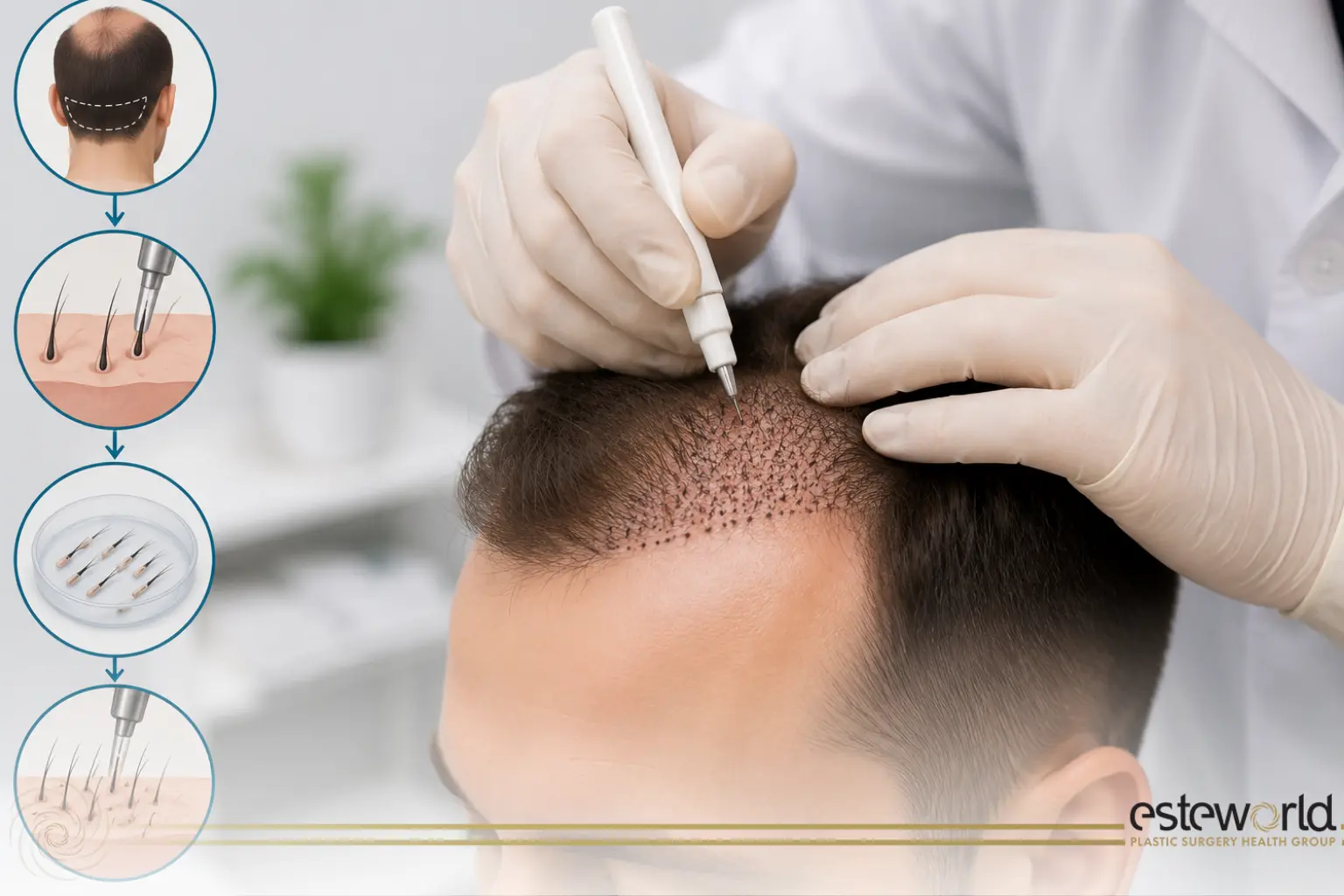
During FUE:
- Suitable follicular units are identified in the donor area.
- A small punch is positioned around each follicular unit.
- Individual units are carefully released and extracted.
- Grafts are preserved until implantation.
- Recipient sites are prepared according to the treatment plan.
- Grafts are implanted according to the desired density, angle and direction.
Compared with FUT, FUE avoids a long linear donor scar.
However, describing FUE as completely “scarless” would be inaccurate. Each extracted follicular unit leaves a very small wound that can heal with a tiny dot-like scar.
Manual, Motorised and Assisted FUE
FUE itself has continued to evolve.
Early extraction could be performed manually. Later systems introduced:
- Motorised punches
- Rotational movement
- Oscillation
- Roto-oscillation
- Suction-assisted systems
- Different punch geometries
- Robotic assistance
A 2025 review of advanced FUE systems notes that developments in punch design and motorised devices have aimed to improve extraction efficiency and reduce follicular damage.
Technology can assist the process, but it does not replace clinical planning or surgical judgement.
How Did Sapphire FUE and DHI Develop From Modern FUE?
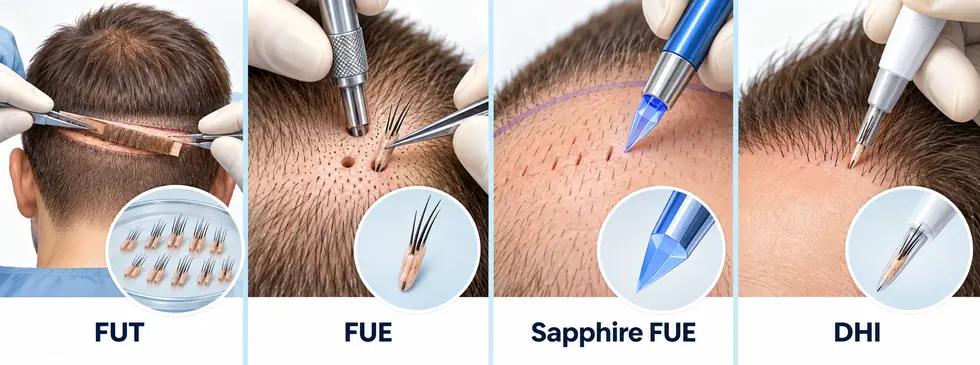
Sapphire FUE and DHI are modern variations in how recipient sites or graft implantation are managed. They should not be interpreted as entirely separate biological forms of hair transplantation, because graft harvesting may still rely on FUE principles.
This distinction is useful because technique names are often used interchangeably in marketing even though they describe different stages of the procedure.
What Is Sapphire FUE?
In Sapphire FUE, follicular units are typically harvested using the FUE method.
The term “sapphire” refers primarily to the blade material used during recipient-channel creation.
Instead of conventional steel blades, sapphire-tipped blades may be used to create recipient sites before graft implantation.
The surgeon still needs to determine:
- Hairline design
- Recipient-site density
- Angle
- Direction
- Graft distribution
- Appropriate donor harvesting
Sapphire blades are therefore a surgical tool rather than a completely separate method of obtaining donor follicles.
What Is DHI Hair Transplantation?
DHI, or Direct Hair Implantation, generally refers to implantation using an implanter pen.
Prepared follicular units are loaded into the device and placed into the recipient area.
This can allow control over:
- Implantation angle
- Hair direction
- Graft positioning
- Placement between existing hairs in selected cases
Again, DHI does not create a new type of hair follicle.
The most meaningful difference is the implantation workflow and equipment used.
FUE vs Sapphire FUE vs DHI
| Feature | FUE | Sapphire FUE | DHI |
|---|---|---|---|
| Donor harvesting | Individual follicular units | Usually FUE harvesting | Usually FUE harvesting |
| Recipient sites | Created before implantation | Created using sapphire-tipped blades | Placement performed with an implanter device |
| Implantation | Grafts placed into prepared channels | Grafts placed into sapphire-created channels | Grafts implanted using a pen/device |
| Linear FUT scar | No | No | No when FUE harvesting is used |
| Main distinction | Individual graft harvesting | Recipient-channel instrument | Implantation method |
Patients should therefore be cautious about simplistic claims that one modern technique is automatically superior to all others.
The appropriate technique depends on the patient’s:
- Hair-loss pattern
- Donor characteristics
- Number of grafts required
- Existing hair
- Recipient area
- Hair calibre and curl
- Treatment goals
What Are the Benefits of Hair Transplantation With Modern Techniques?
Modern hair transplant techniques provide greater control over follicular-unit harvesting, hairline design, graft distribution, angle and direction compared with early large-graft procedures. They have also expanded the range of donor-harvesting and implantation options available to surgeons.
The original Esteworld article already targeted “benefits of hair transplantation with modern techniques”, so this heading should remain.
The benefits can include:
- More natural distribution of follicular units
- Greater control over frontal hairline design
- More precise placement of single-hair grafts at the hairline
- Reduced risk of a plug-like appearance
- Ability to tailor graft distribution to different scalp zones
- FUE donor harvesting without a long linear strip scar
- Improved tools for individual follicular-unit extraction
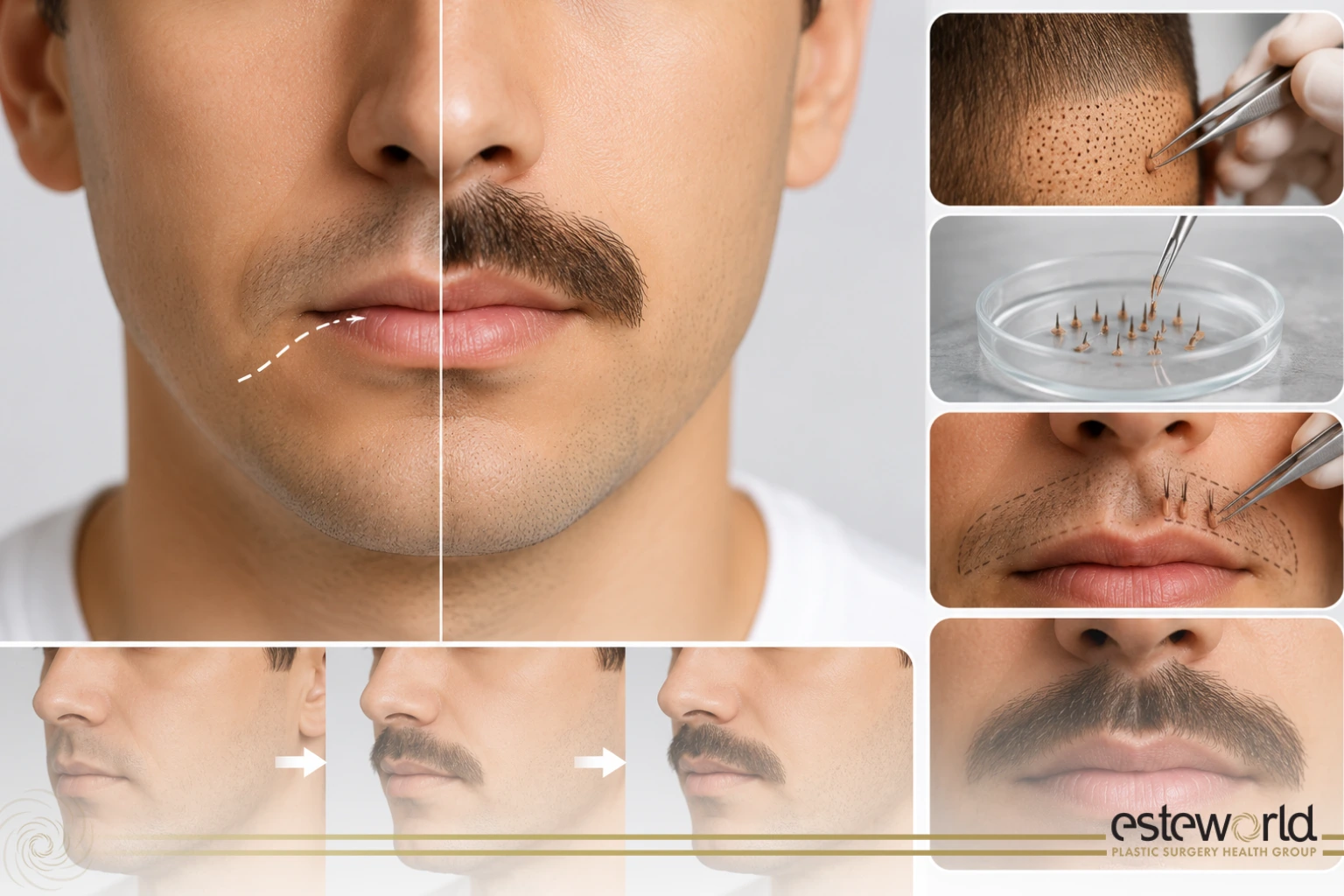
- Greater flexibility in eyebrow, beard and moustache restoration
- More personalised treatment planning
However, modern technology does not remove every risk or guarantee a successful result.
The previous version of this article stated that patients could expect treatment “free of any negative symptoms or complications.” That claim should not remain.
Hair transplantation is a surgical procedure and potential complications can include:
- Swelling
- Temporary numbness
- Infection
- Folliculitis
- Bleeding
- Scarring
- Shock loss
- Unsatisfactory density
- Donor-area overharvesting
- Poor graft growth
The likelihood depends on individual factors, planning, technique and surgical execution.
Likewise, hair transplantation does not guarantee that “hair loss is no longer a recurring problem.”
Transplanted follicles from an appropriate donor zone may retain long-term growth characteristics, but surrounding native hair can continue to thin because the underlying androgenetic alopecia may still progress.
That distinction is important when explaining the actual benefit of modern techniques.
Which Hair Transplant Technique Is Used Today?
FUE-based harvesting is widely used in contemporary hair restoration, while FUT remains an established option in selected patients. Sapphire FUE and DHI represent variations in recipient-site creation and implantation rather than evidence that older accepted surgical principles have become irrelevant.
Current hair restoration therefore involves several possible approaches:
- FUT
- Manual FUE
- Motorised FUE
- Sapphire FUE
- DHI
- Robotic or assisted FUE systems
- Combined approaches in selected cases
The “newest” technique is not automatically the most appropriate technique for every patient.
Does a Newer Hair Transplant Technique Mean a Better Result?
Not necessarily.
A natural hair transplant depends on many variables beyond the device or technique name.
These include:
- Correct diagnosis
- Patient selection
- Donor management
- Graft extraction quality
- Hairline design
- Graft handling
- Recipient-site planning
- Direction and angle
- Density distribution
- Postoperative care
Modern equipment can support precision, but poor planning cannot be corrected simply by using a newer instrument.
This is one of the most important lessons in the evolution of hair transplantation: technology has changed, but clinical judgement remains central.
The 2025 historical review similarly describes modern hair restoration as a progression toward greater precision and patient-centred care rather than simply a succession of devices.