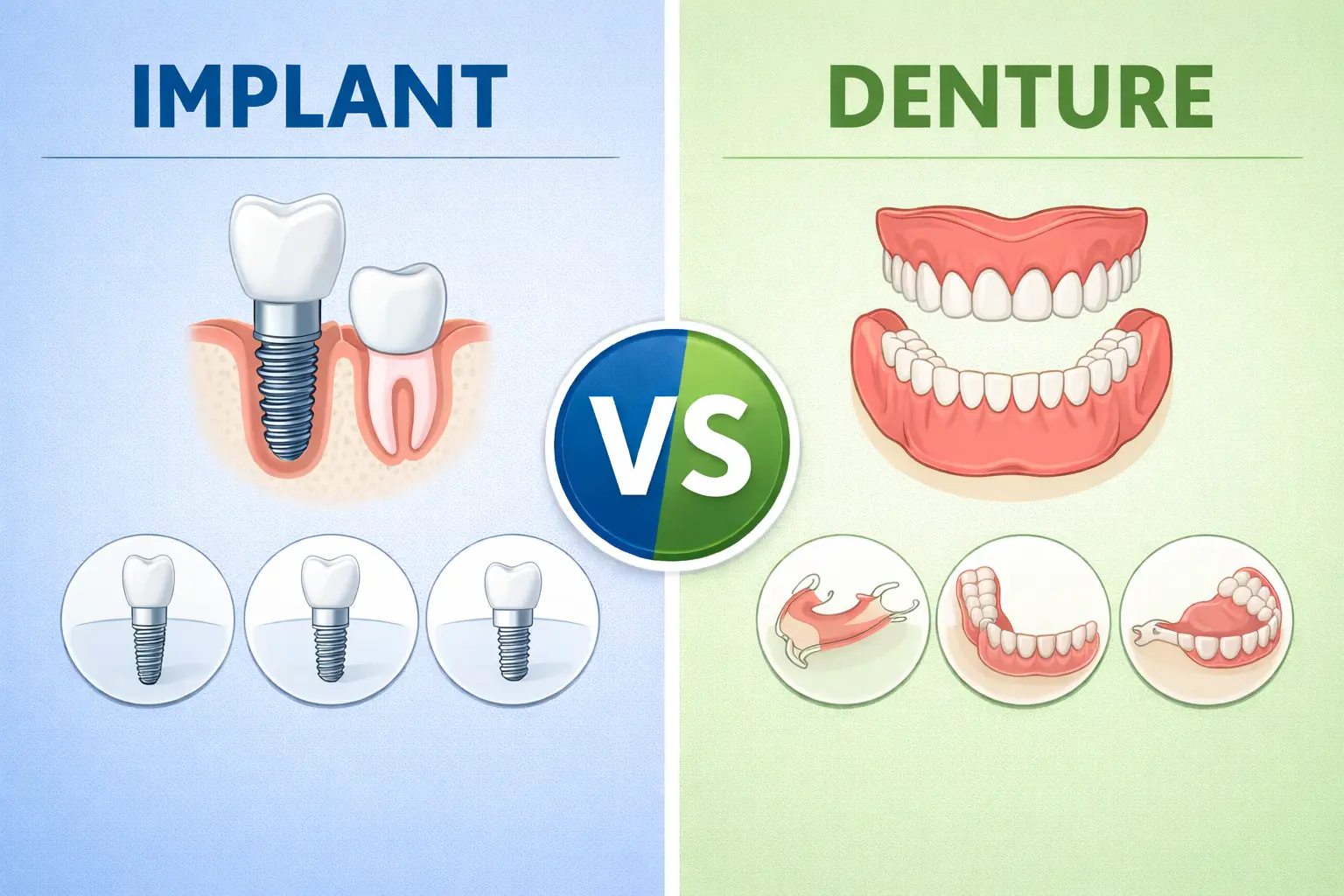
Many people who experience tooth loss find themselves asking a similar question: Implant or denture? Today, these two methods are among the most commonly preferred solutions for the treatment of missing teeth. Both aim to improve chewing function and aesthetic appearance; however, their application methods and the advantages they offer differ from one another.
When deciding between implant and denture treatments, rather than asking “Which one is better?”, it is more appropriate to focus on “Which method is more suitable for me?” Oral structure, the condition of tooth loss, expectations, and lifestyle habits directly affect this choice.
A denture is an artificial tooth application used to replace missing teeth and support chewing and speech functions. It helps preserve aesthetic appearance and restore oral functions in individuals who experience tooth loss.
Dentures can be planned as fixed or removable, depending on the number of missing teeth, oral structure, and individual needs. Fixed dentures are generally supported by existing teeth, while removable dentures have a structure that can be taken in and out. The type of denture to be preferred is determined as a result of an evaluation performed by a dentist.
Denture treatment may be an advantageous option for some patients as it does not require a surgical procedure and can be applied in a shorter period of time. However, usage habits, oral care, and regular check-ups are important in terms of comfort and longevity.
An implant is an artificial tooth root, usually made of titanium, that is placed into the jawbone to replace missing teeth. With the prosthetic tooth placed on top of this artificial root, both aesthetic appearance and chewing function can be restored.
Implant treatment is applied surgically to the bone in the area where the tooth is missing. After the implant completes its integration with the bone, a fixed prosthetic tooth is placed on top. In this way, a usage sensation similar to a natural tooth is aimed.
One of the prominent features of implant treatment is that it can be applied without intervening in neighbouring teeth. However, whether it is suitable for every patient should be evaluated by a dentist by considering factors such as jawbone structure, general health status, and oral hygiene.
Although denture and implant treatments both aim to eliminate tooth deficiencies, they differ in terms of application method, usage comfort, and long-term effects. The table below clearly and comparatively shows the main differences between the two methods.
Comparison Criteria | Denture | Implant |
Application Method | Supported by existing teeth or gums | Applied onto an artificial tooth root placed in the jawbone |
Surgical Procedure | Not required | Requires a surgical procedure |
Usage Type | Can be fixed or removable | Fixed structure |
Chewing Comfort | May vary from person to person | Provides chewing sensation close to a natural tooth |
Effect on Adjacent Teeth | Load may be placed on supporting teeth | No intervention to adjacent teeth |
Effect on Bone | Does not prevent bone loss | Helps preserve the jawbone |
Usage Duration | Depends on care and usage | Can be used for many years with proper care |
Preferred Situations | Multiple missing teeth, patients who do not want surgery | Single or multiple missing teeth, patients seeking a fixed solution |
Dentures may be suitable for individuals who do not want a surgical procedure or who are looking for a quicker solution. Implant treatment, on the other hand, offers a long-term solution thanks to its fixed structure and positive effects on the bone. The most appropriate choice should be determined through a dentist’s evaluation based on oral structure and personal expectations.
It is not possible to speak of a single correct option when deciding between dentures and implants. The right choice should be determined according to personal needs and oral structure. The following points may help facilitate the decision-making process:
The ideal solution differs for every patient. The healthiest decision should be made in line with a detailed evaluation of oral and jaw structure and the recommendation of a dentist. You may contact us to receive detailed information about denture and implant treatments.
There is no single option that is “better” between implants and dentures. Which treatment is suitable is determined by considering oral structure, the condition of tooth loss, expectations, and general health status. The most accurate decision is made through a dentist’s evaluation.
The “best” removable denture varies from person to person. Fixed dentures provide a more natural feeling, while removable dentures may be more suitable in some cases. The number of missing teeth and oral structure are determining factors in this preference.
Dentures that are properly planned and regularly maintained can be functional in daily use. However, the adaptation period, maintenance requirements, and usage comfort may vary from person to person.
Implants can be used for many years when proper care is provided. The lifespan of dentures may vary depending on maintenance, usage habits, and oral structure.
Both treatments can provide aesthetic results with proper planning. However, implants often offer an appearance closer to natural teeth due to their fixed structure.
As Esteworld Health Group, Turkey’s leading provider of plastic and aesthetic surgery services, we have been offering aesthetic services at the highest medical standards since 1994 under the slogan “Healthy beauty!”


By Metrobus:
You can get off the Metrobus at Uzunçayır station and then take the minibuses and buses to Metropol Shopping Mall.
Bus Transportation:
You can take buses numbered 8K-10-10A-10EK-13-13ŞB-13AB-14ŞB-16M-19EK-19M-KM46-256 and get off at Ataşehir Plazalar stop.
Transportation by minibus:
You can take Üsküdar-Ferhat Paşa, Üsküdar-Ataşehir, Ümraniye-Ataşehir minibuses and get off at Ataşehir Plazalar stop.
By Metro
You can use the M4 Kadıköy-Sabiha Gökçen metro line and get off at Yenisahra or Kozyatağı stops and then take buses and minibuses to Metropol AVM.
Transportation from Sabiha Gökçen Airport:
You can take the M4 Kadıköy-Sabiha Gökçen metro line and get off at the Kozyatağı stop and then take the minibuses and buses to Ataşehir Metropol AVM.