Table of Contents

FUE or DHI? Differences Between Hair Transplant Methods

FUE or DHI? Differences Between Hair Transplant Methods

Many people considering a hair transplant find themselves asking a similar question: FUE or DHI? These two methods, which are among the most preferred today, aim to provide natural and permanent results. However, their application techniques and the situations in which they are preferred differ from one another.

In both methods, hair follicles are taken from the donor area and transplanted into sparse or bald areas. Nevertheless, there are important differences in terms of the technique used, the planning process, and the healing period. For this reason, rather than asking “Which method is better?”, it is more appropriate to ask “Which method is more suitable for me?”

Making the right choice based on the current condition of the hair, the level of hair loss, and personal expectations directly affects the natural appearance of the final result. In this content, we aim to make your decision-making process clearer and easier by addressing the fundamental differences between FUE and DHI hair transplant methods.

What Is FUE Hair Transplant?

FUE (Follicular Unit Extraction) is one of the most commonly preferred modern hair transplant methods today. In this technique, hair follicles are extracted one by one from the donor area using micro motors and then transplanted into bald or sparse areas. The fact that no incisions or stitches are required during the procedure is one of the prominent features of the FUE method.

Since the hair follicles are extracted individually, the risk of visible scarring in the donor area is low. This contributes to a more comfortable healing process. The FUE method is frequently preferred, especially for individuals experiencing advanced hair loss, as it allows transplantation over large areas.

The planning stage is of great importance in FUE hair transplantation. Determining the hairline, distributing the transplantation area, and deciding on the number of grafts are planned by taking into account the individual’s facial structure, hair characteristics, and existing hair density. With proper planning, a natural and balanced appearance is aimed.

This method can be applied using different techniques such as classic FUE and sapphire FUE. Which technique will be preferred is determined through expert evaluation based on the individual’s hair structure and needs.

What Is DHI Hair Transplant?

DHI (Direct Hair Implantation) is a hair transplant method in which hair follicles are placed directly into the recipient area using a special pen. In this technique, after the hair follicles are taken from the donor area, they are implanted using a special device called a Choi implanter, without opening channels.

Since channel opening and implantation are performed simultaneously in the DHI hair transplant method, the transplantation process progresses in a more controlled manner. This allows denser implantation with accurately planned angles and directions, especially in sensitive areas such as the hairline and frontal region.

The DHI method is generally preferred by individuals who want hair transplantation in limited areas and aim to preserve their existing hair. However, whether it is suitable for each patient should be evaluated by a specialist based on hair loss condition and expectations.

What Are the Advantages of the FUE Hair Transplant Method?

  • Since hair follicles are extracted individually from the donor area, the risk of visible scarring is low.
  • As it does not require incisions or stitches, the healing process is generally more comfortable.
  • It allows hair transplantation over large areas.
  • Hair from the donor area can be extracted while preserving natural distribution.
  • A natural hairline can be created with proper planning.
  • It offers flexibility as it can be applied with different techniques such as sapphire FUE.
  • The return to daily life is short for most patients.
  • It is suitable for both frontal and crown area transplantation.

What Are the Advantages of the DHI Hair Transplant Method?

  • Since hair follicles are placed directly into the recipient area without opening channels, it provides a more controlled application.
  • Thanks to the Choi implanter pen, the direction and angle of hair follicles can be adjusted more precisely.
  • Natural results can be achieved, especially in areas requiring detail such as the hairline and frontal region.
  • It allows transplantation between existing hair.
  • It may offer unshaven or partially shaved application options.
  • It enables denser and more concentrated implantation.
  • As the implantation process progresses in a controlled manner, the time hair follicles remain outside the body may be reduced.

It is suitable for individuals who want hair transplantation in limited areas.
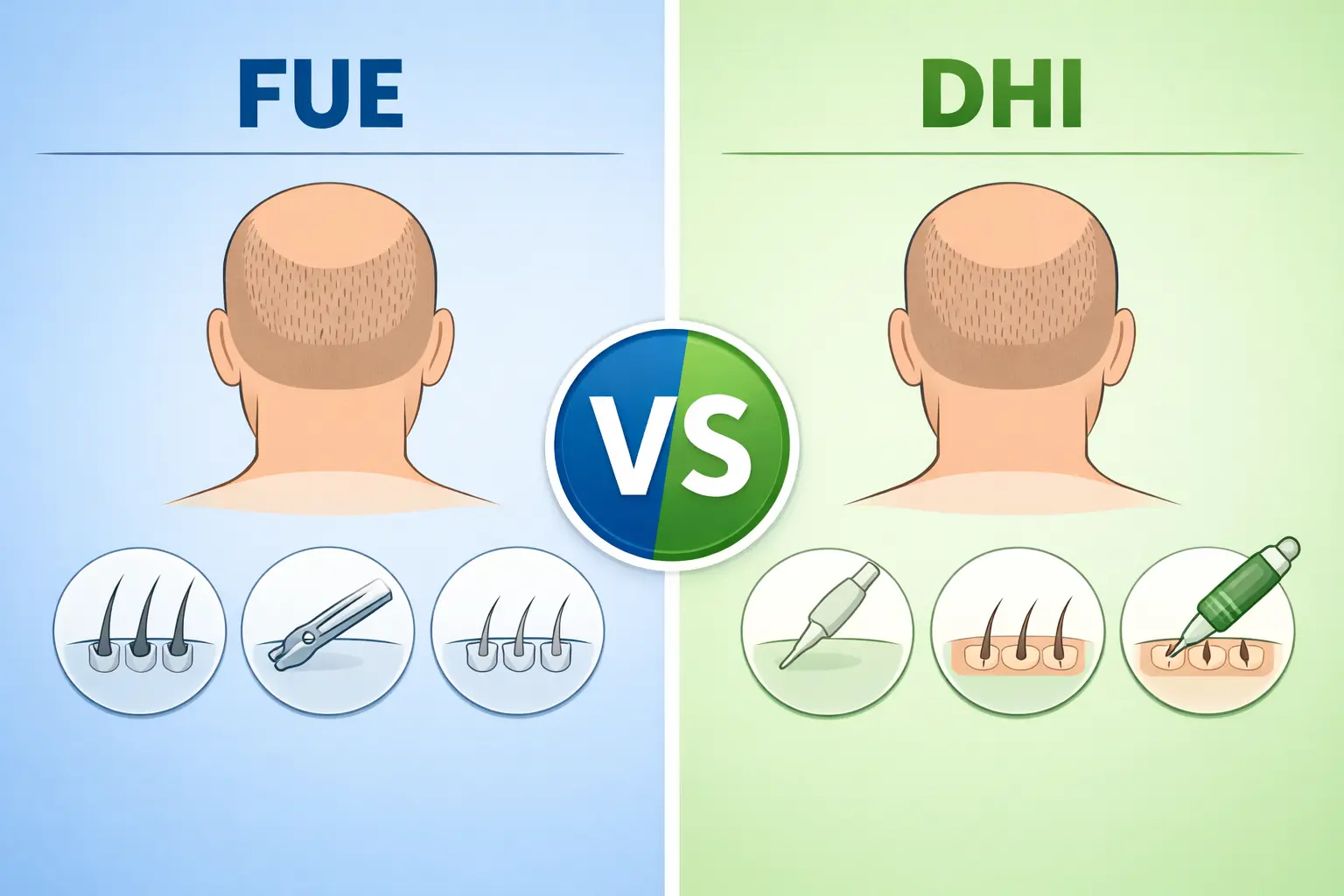
FUE vs DHI: Which Method Should I Choose?

When choosing between FUE and DHI methods, rather than asking “Which one is better?”, it should be evaluated which one is more suitable for personal needs. The main factors affecting the choice are as follows:

  • If transplantation is planned over large areas, the FUE method may be more suitable. DHI may be preferred for limited and detail-oriented areas.
  • If transplantation between existing hair is planned, the DHI method offers an advantage.
  • If more controlled and dense planning is desired for the frontal hairline, DHI stands out.
  • Although the healing process varies from person to person in both methods, planning and application techniques may affect comfort.
  • The thickness and density of hair follicles and the adequacy of the donor area are determining factors in method selection.
  • The most appropriate method should be determined through detailed hair analysis and specialist evaluation.

There is no single ideal method for every patient. Personalised planning is of great importance for achieving a natural and balanced result.

FUE vs DHI: What Is the Healing Process Like?

The healing process in FUE and DHI hair transplant methods may vary depending on the application technique and the individual’s skin structure. In both methods, the aim is for the post-transplant period to progress in a controlled and comfortable manner.

  • First days: Mild redness and scabbing may be observed in the transplanted area in both methods. This is considered normal.
  • Scabbing period: Scabs usually fall off on their own within the first 7–10 days.
  • Return to daily life: Most people can return to daily life within a few days. Medical advice should be followed for physical activities.
  • Shock loss: Temporary shock loss may occur in the first weeks after transplantation. This is a natural part of the process.
  • Hair growth process: New hair usually begins to grow from the third month, and results gradually become more noticeable.
  • Final results: In both FUE and DHI methods, final results are generally evaluated within an average of 12 months.

Following post-transplant care instructions is very important for a healthy healing process. The process may vary depending on individual factors.

FUE vs DHI Hair Transplant Methods: What Are the Differences?

Although FUE and DHI hair transplant methods serve the same purpose, they involve some fundamental differences in terms of application technique and reasons for preference. These differences may directly affect method selection.

Differences


FUE Hair Transplant

DHI Hair Transplant

Application Method

Hair follicles are implanted after channels are opened

Hair follicles are implanted directly using a special pen without opening channels

Equipment Used

Micro motor and channel-opening tools

Choi implanter pen

Implantation Density

Suitable for large areas

Allows denser and more controlled implantation

Preservation of Existing Hair

Preferred for wide bald areas

Suitable for implantation between existing hair

Hairline Planning

Natural results can be achieved

Provides more precise control in the frontal hairline

Healing Process

Varies by individual

Varies by individual

Preferred Areas

Large and bald areas

Limited and detail-oriented areas

While the FUE method provides an advantage in covering large areas, the DHI method stands out in cases requiring more controlled and dense implantation. The most appropriate method selection should be determined based on personal hair structure and expectations. You may contact us to receive detailed information about FUE and DHI hair transplantation.

CURIOSITIES ABOUT FUE VS DHI
FUE or DHI? Differences Between Hair Transplant Methods
No question marks in your mind?
You can contact us for information about hair transplantation and treatments.
Is FUE or DHI better?

There is no single method that is “better” between FUE and DHI. The most suitable method varies depending on hair loss level, hair structure, and expectations.

The main difference is the implantation technique. In FUE, channels are opened first, whereas in DHI, implantation is performed directly without opening channels.

In both methods, the healing process depends on the individual. Post-procedure care and skin structure directly affect recovery.

If implantation between existing hair is planned, the DHI method may be more suitable.

If hair transplantation is planned over large areas, the FUE method is more advantageous.

If denser and more controlled planning is desired in the frontal hairline, the DHI method may be preferred.

In both methods, hair follicles taken from the donor area are permanent. Final results appear gradually over time.

ESTEWORLD
WE ARE IN 35 COUNTRIES IN THE WORLD

As Esteworld Health Group, Turkey’s leading provider of plastic and aesthetic surgery services, we have been offering aesthetic services at the highest medical standards since 1994 under the slogan “Healthy beauty!”

Hair Transplant Operations
0 +
Plastic Surgery Operations
0 +
Dental Treatments
0 +
FUE or DHI? Differences Between Hair Transplant Methods
Achievements and Certificates
THE HOSPITAL THAT MAKES YOU SMILE
We provide services with high medical standards; we offer solutions in hair transplantation, plastic surgery, longevity, dental and medical aesthetics with our expert staff.
FUE or DHI? Differences Between Hair Transplant Methods
ESTEWORLD
ESTEWORLD
Welcome to Esteworld. How can we help you?

Transportation to Atasehir Clinic by Public Transportation:

By Metrobus:

You can get off the Metrobus at Uzunçayır station and then take the minibuses and buses to Metropol Shopping Mall.

Bus Transportation:

You can take buses numbered 8K-10-10A-10EK-13-13ŞB-13AB-14ŞB-16M-19EK-19M-KM46-256 and get off at Ataşehir Plazalar stop.

Transportation by minibus:

You can take Üsküdar-Ferhat Paşa, Üsküdar-Ataşehir, Ümraniye-Ataşehir minibuses and get off at Ataşehir Plazalar stop.

By Metro

You can use the M4 Kadıköy-Sabiha Gökçen metro line and get off at Yenisahra or Kozyatağı stops and then take buses and minibuses to Metropol AVM.

Transportation from Sabiha Gökçen Airport:

You can take the M4 Kadıköy-Sabiha Gökçen metro line and get off at the Kozyatağı stop and then take the minibuses and buses to Ataşehir Metropol AVM.